A classic cruise visits Karnak and Luxor Temple at Luxor, the Valley of the Kings and Hatshepsut on the West Bank, the Temple of Horus at Edfu, the double temple at Kom Ombo, and Philae at Aswan. Six sites in three or four days. Abu Simbel and Dendera are add-ons, not part of the standard programme.
A standard Aswan–Luxor cruise visits eight sites: Philae, Kom Ombo, Edfu, the Esna area, Karnak, Luxor Temple, the Valley of the Kings and Hatshepsut’s temple, plus the Colossi of Memnon. Abu Simbel is not included — it sits 280km south of Aswan and is sold as a separate excursion. The stops are identical in both directions; only the order changes.
What follows is what each one actually is, how long you get, and which are worth the extra ticket.
Key takeaways
Six sites in three or four days: Karnak, Luxor Temple, the Valley of the Kings, Hatshepsut, Edfu and Kom Ombo — plus Philae at Aswan.
Every classic itinerary visits the same ones, in one order or the other.
Abu Simbel and Dendera are add-ons, not part of the programme.
Standard tickets are included; three tombs are extra.
The full list
Site
Where
Time there
Included?
Philae Temple
Aswan
90 min
Yes
Unfinished Obelisk
Aswan
30 min
Yes
High Dam
Aswan
30 min
Yes
Kom Ombo
Kom Ombo
75 min
Yes
Temple of Horus
Edfu
90 min
Yes
Valley of the Kings
Luxor West
2 hrs
3 tombs included
Hatshepsut Temple
Luxor West
60 min
Yes
Colossi of Memnon
Luxor West
15 min
Yes
Karnak
Luxor East
2 hrs
Yes
Luxor Temple
Luxor East
75 min
Yes
Abu Simbel
280km S of Aswan
Full day
No
Edfu is the best-preserved temple in Egypt and the one most people are surprised by.
Philae — the last temple of the old religion
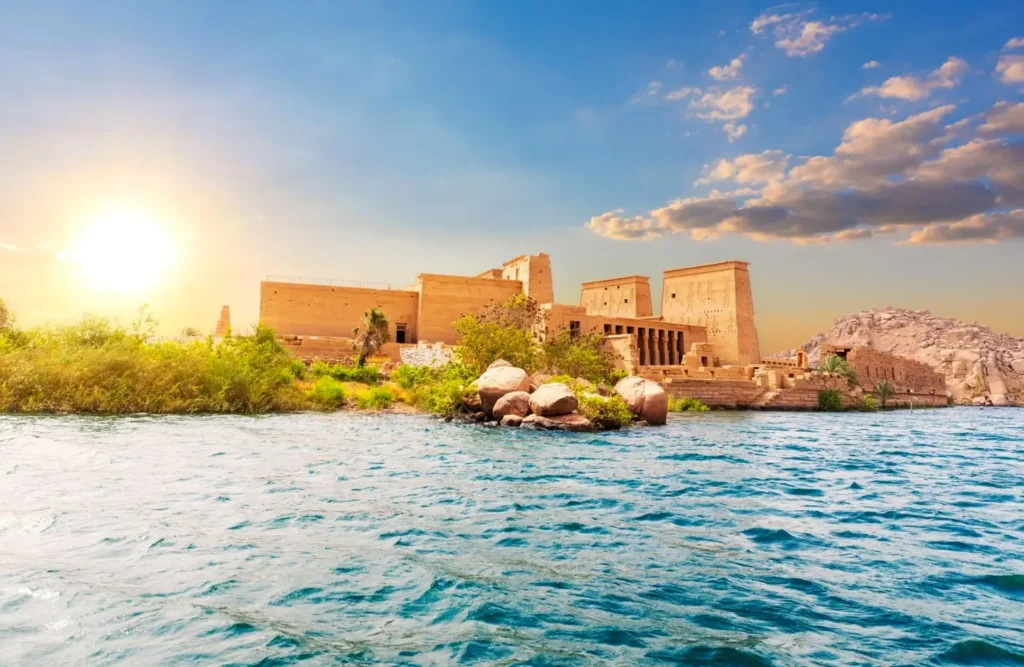
On an island reached by motorboat, dedicated to Isis, and the final place in Egypt where the ancient religion was still practised — into the sixth century AD, long after the rest of the country had turned Christian.
Philae was moved. When the High Dam created Lake Nasser, the original island flooded, and between 1972 and 1980 the entire temple was cut into 40,000 blocks and rebuilt on higher ground at Agilkia. It was done so precisely that most visitors never notice.
Go at sunset if your itinerary allows. The granite turns orange and the boat ride back across the water is the best twenty minutes in Aswan.
Kom Ombo — the double temple
Unique in Egypt: two temples in one, perfectly symmetrical, sharing a central axis. The southern half belongs to Sobek, the crocodile god; the northern half to Horus the Elder. Two entrances, two sanctuaries, two of everything.
It sits directly on the bank — you step off the boat and you are there, which after two days of coaches feels like a small luxury.
The crocodile museum next door holds about forty mummified crocodiles recovered from the area, some of them enormous. It takes fifteen minutes and it is better than it sounds.
Look for the relief usually described as surgical instruments — scalpels, forceps, suction cups. Egyptologists disagree about what it actually depicts, and a good guide will tell you that rather than presenting the tourist version as settled fact.
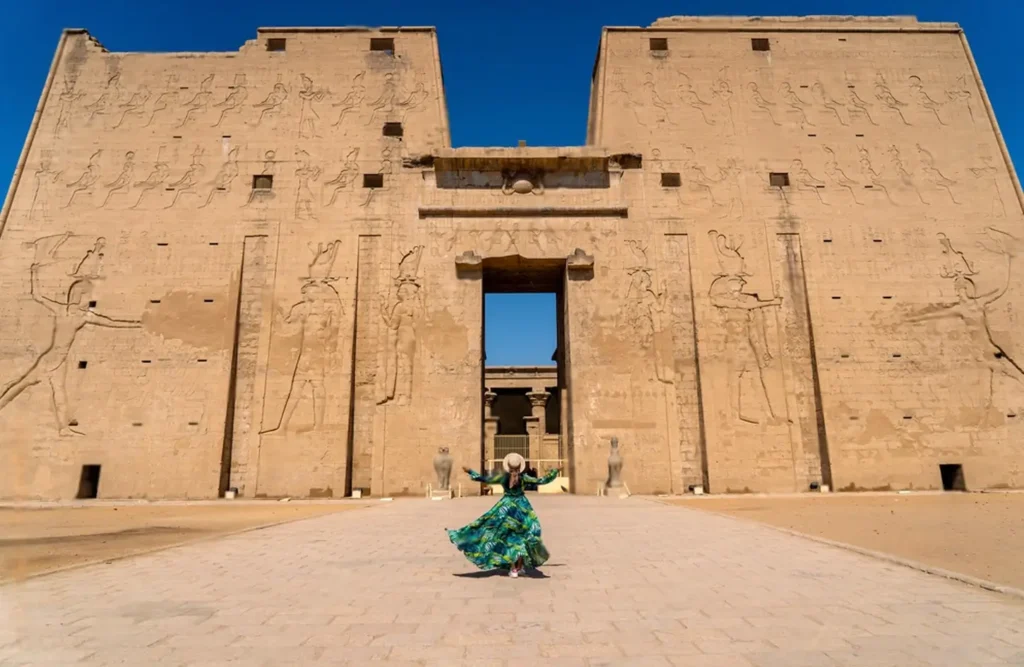
Edfu is the surprise. It is the best-preserved temple in Egypt and the one most people arrive at expecting the least.
Edfu — the best-preserved temple in Egypt
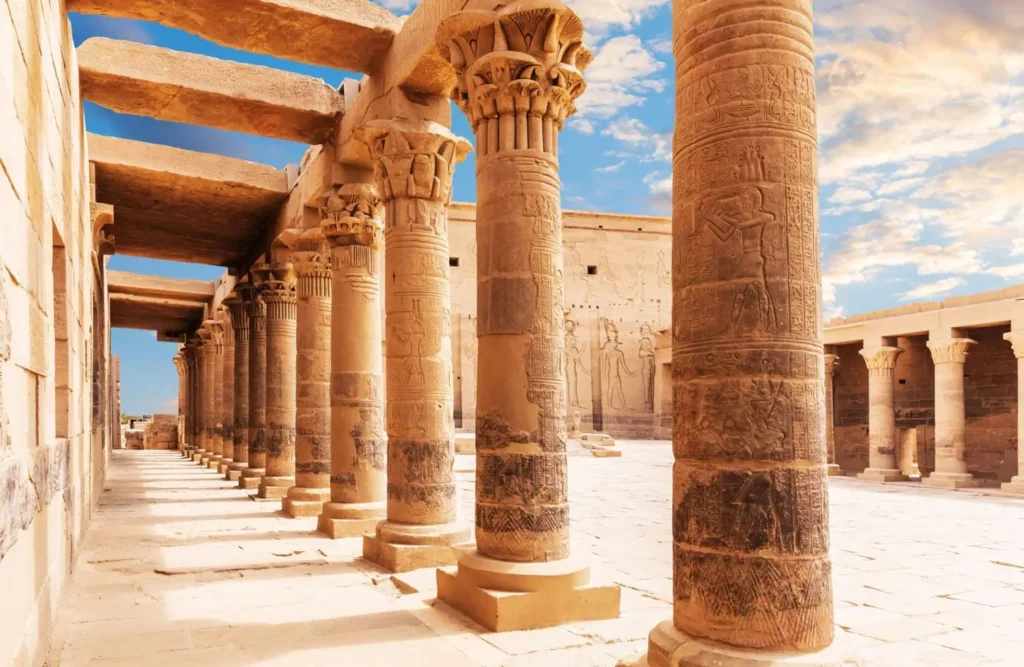
If you see one temple with its roof on, this is it.
The Temple of Horus at Edfu was finished around 57 BC, which makes it Ptolemaic — a thousand years younger than Karnak, built by Greek pharaohs copying a style already ancient to them. That youth is why it survived: it was buried in sand and silt for centuries and excavated largely intact.
Walking out of the sun into the hypostyle hall, with the roof overhead and the columns going back into the dark, is the closest you will come on this trip to seeing an Egyptian temple as it was meant to be experienced.
Getting there from the dock is by horse-drawn carriage, about fifteen minutes through town. We will be straight with you: the horses are not always well kept, and some travellers find it upsetting. A minibus can be arranged instead — just ask, it is a routine request and nobody will be offended.
Philae closes the route at Aswan — the only one of the six you reach by boat.
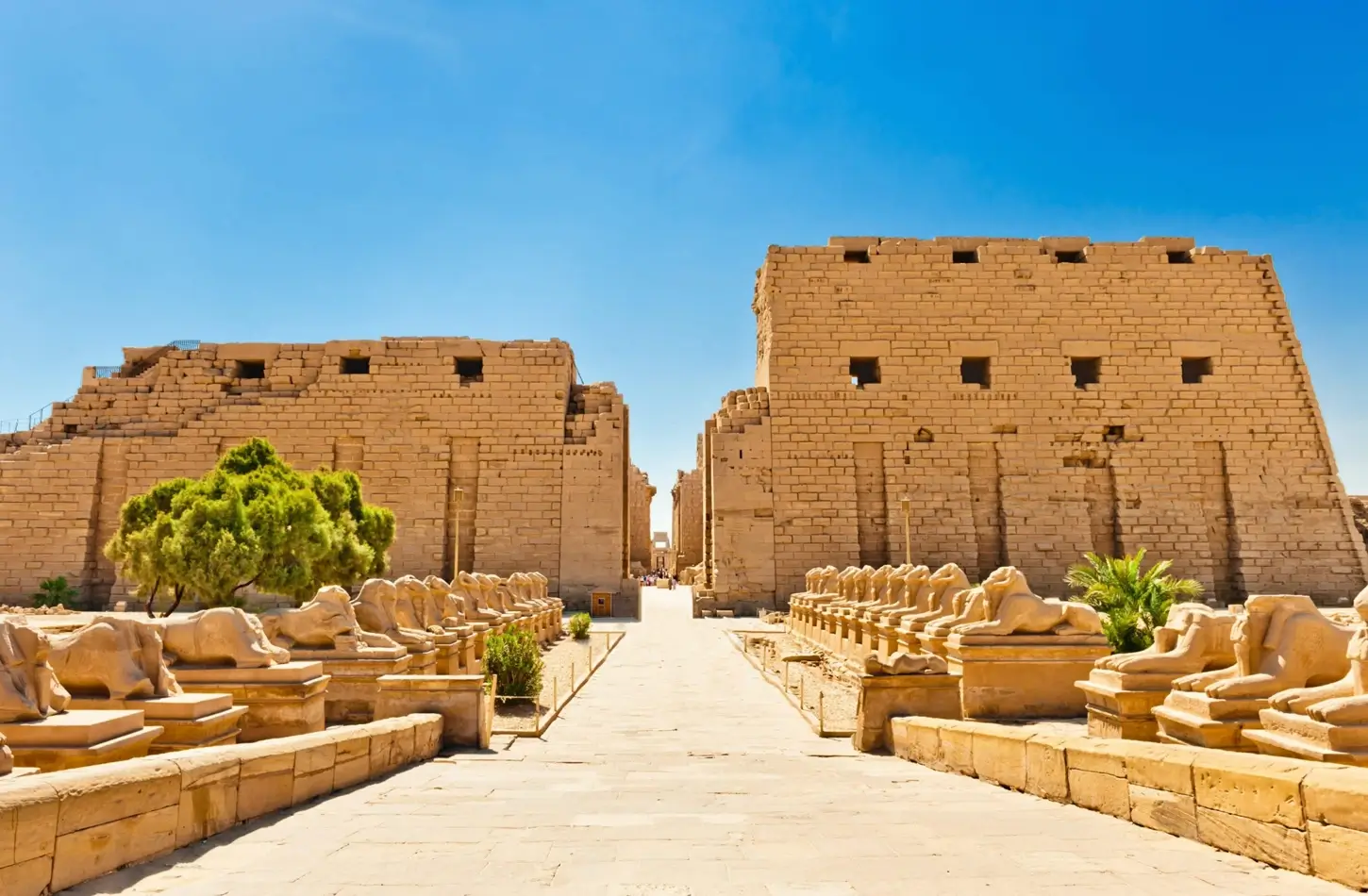
Karnak — the largest religious building ever constructed
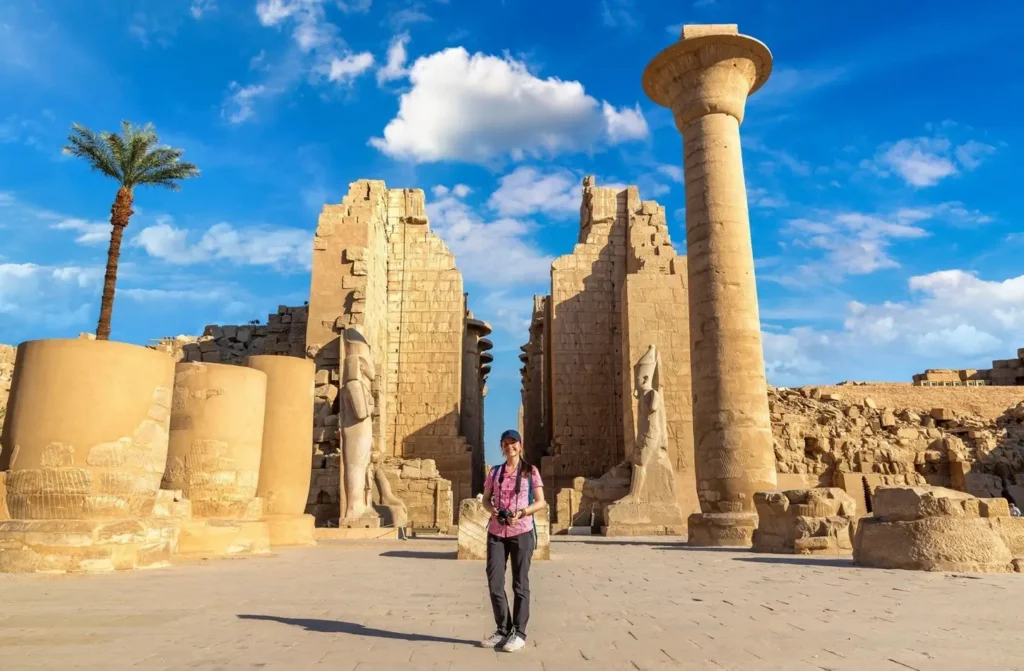
Two hundred acres. Built, extended, demolished and rebuilt across roughly 1,500 years by around thirty pharaohs. It is less a temple than a city of temples.
The Great Hypostyle Hall is the reason people come — 134 columns in sixteen rows, the tallest 21 metres, carved from base to capital. Standing under them is the single most photographed interior in Egypt and it still works.
Also worth finding: the avenue of ram-headed sphinxes at the entrance, Hatshepsut’s obelisk at nearly 30 metres, and the Sacred Lake at the back where far fewer people go.
Two hours minimum. Wear proper shoes.
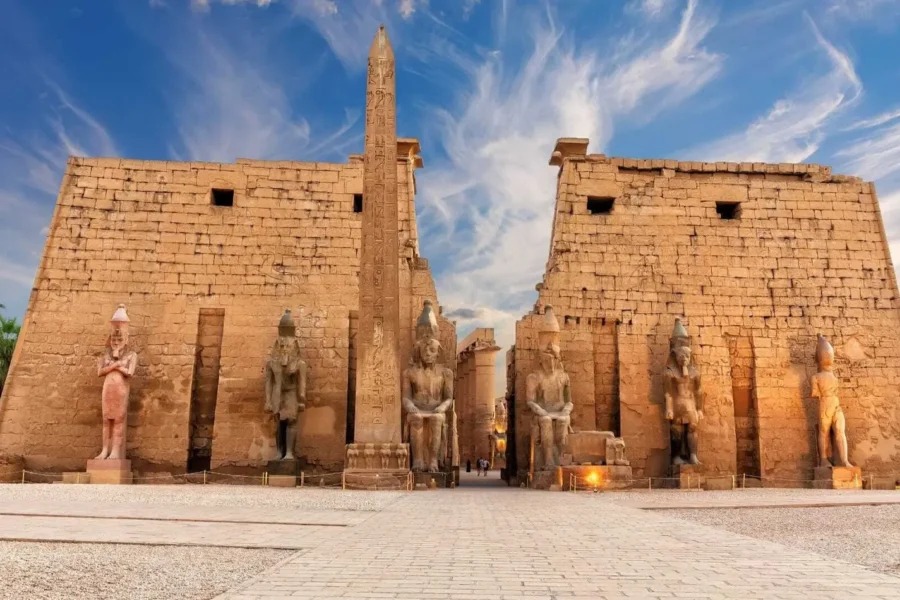
Luxor Temple — better in the evening
Smaller than Karnak and much easier to take in. It sits in the middle of modern Luxor, connected to Karnak by the recently restored Avenue of Sphinxes — nearly three kilometres of it.
Luxor Temple has one detail nothing else in Egypt has: a functioning mosque built into its upper level, the Abu Haggag mosque, placed there when the temple was still buried and left in place after excavation. You can see the doorway hanging metres above the ancient floor.
If your itinerary offers it after dark, take that option. It is floodlit and considerably better than in daylight.
The Valley of the Kings — and which extra tomb to buy
Sixty-three known tombs cut into the limestone of a desert valley, of which around ten are open at any time on a rotating schedule to spread the wear.
Your standard ticket admits you to three. Which three depends on what is open that week; your guide will steer you toward the best of the rotation.
Three tombs carry separate tickets:
Tutankhamun — famous, and honestly underwhelming as architecture. Small, plain, and the treasures are in Cairo. The mummy is there, which is the draw.
Seti I — the most expensive ticket in the valley and the best thing in it. 137 metres of decorated corridor, colours that look freshly applied. If you buy one extra, buy this.
Ramesses V and VI — spectacular astronomical ceiling, and cheaper than Seti I.
Guides are not permitted to lecture inside the tombs. They brief you outside, then you go in alone. Photography rules change; a permit is sometimes required.
Hatshepsut and the Colossi
Deir el-Bahari is the mortuary temple of Hatshepsut, one of the few women to rule Egypt as pharaoh — three terraces built straight into a cliff face, and from a distance one of the most dramatic structures in the country. Up close, be warned: the courtyard is a limestone bowl with almost no shade.
The Colossi of Memnon are a fifteen-minute photo stop. Two 18-metre statues of Amenhotep III, all that remains of a mortuary temple that was once larger than Karnak and was destroyed by earthquake and flood.
Karnak's hypostyle hall holds 134 columns; the tallest stand about 21 m, and the middle of the hall stays shaded most of the day.
Abu Simbel — not included, and you should go anyway
Four seated colossi of Ramesses II, each 20 metres tall, carved into a sandstone cliff above Lake Nasser. Like Philae it was moved to escape the rising water — cut into blocks and reassembled 65 metres higher in the 1960s.
It is not part of any cruise itinerary. From Aswan it is roughly three and a half hours each way by road, about ten hours all in, and costs $85 to $160. By air it is 45 to 60 minutes each way at $200 to $300.
Twice a year, on 22 February and 22 October, the rising sun travels 60 metres into the temple and lights three of the four statues in the inner sanctuary. That alignment was designed more than three thousand years ago and survived the relocation.
Photography, tickets and the practical bits
Rules change often enough that your guide is the reliable source on the day, but the shape of it is consistent.
Photography is free at open-air temples — Karnak, Luxor, Edfu, Kom Ombo, Philae. Bring what you like.
Tombs are different. A photography permit is required in the Valley of the Kings, bought at the ticket office, and it does not always cover the separately-ticketed tombs. Flash is prohibited everywhere underground, and it is enforced — the pigment is genuinely damaged by it. Tripods need advance permission.
Guides cannot lecture inside tombs. Egyptian regulation. Your Egyptologist briefs you fully at the entrance and then you go in alone, which is why a good guide matters more than people assume — the whole explanation happens before you see the thing.
Tickets are sold at each site’s gate, and on a packaged cruise your guide handles all of it. If you have bought a cruise-only fare with no guide, you buy your own and the total across the route runs $70 to $90 per person at current prices.
How to get more out of each temple
Four things that cost nothing and change the visit considerably.
Ask to go early. Ships work to a standard departure time, but guides can almost always take you at opening if you ask the night before. Karnak at 6am in summer or 7:30 in winter is a different building.
Pick one thing per temple. These sites are overwhelming and everybody photographs the same three views. Choose something specific to look for — the Nilometer at Kom Ombo, the sacred lake at Karnak, the unfinished column capitals at Edfu — and the visit stops blurring into the last one.
Look up. Ceilings survive better than walls. The astronomical ceiling at Dendera and the vulture ceilings at Edfu and Kom Ombo hold colour that the walls lost centuries ago.
Stay ten minutes after your group moves on. Nobody minds, the guide will wait, and a hypostyle hall with the group gone is the memory you actually keep.
Philae was moved block by block to Agilkia island in the 1970s to save it from the water behind the High Dam.
What you will not see, and why
Dendera and Abydos are north of Luxor, so they appear only on the 7-night round trip or as a land excursion. The Valley of the Queens, including Nefertari’s tomb, is usually an add-on rather than standard. Medinet Habu and the Ramesseum are rarely included and are both excellent — ask if you have a spare afternoon in Luxor.
Philae, Kom Ombo, Edfu, Karnak, Luxor Temple, the Valley of the Kings, Hatshepsut and the Colossi of Memnon, plus the High Dam and Unfinished Obelisk at Aswan.
Is Abu Simbel included in a Nile cruise?
No. It is 280km south of Aswan, off the cruise route, and sold separately — $85 to $160 by road or $200 to $300 by air.
Do you visit the Valley of the Kings on a Nile cruise?
Yes, on the Luxor West Bank. The standard ticket covers three tombs from a rotating selection. Tutankhamun, Seti I and Ramesses V/VI require separate tickets.
Is Karnak included?
Yes, on every Luxor–Aswan itinerary, usually with Luxor Temple on the same day. Allow two hours for Karnak alone.
Do you see different temples depending on direction?
No. Both directions cover the same sites. Only the sequence changes — see our direction comparison.
Which extra tomb is worth paying for?
Seti I. It is the most expensive ticket in the Valley of the Kings and by a wide margin the most impressive tomb open to visitors.
How long do you spend at each temple?
Between 75 minutes and two hours for the major sites, 15 to 30 minutes for stops like the Colossi and the Unfinished Obelisk.
Do I have to take the horse carriage at Edfu?
No. A minibus can be arranged instead, and it is a normal request if the condition of the horses concerns you.
Want the route that covers them all?
Send us your dates and a rough budget — a specialist replies with three ships across categories, live availability and a written price. No online payment.
Written byMagdy Fattouh38 guides published on this site
Magdy Fattouh is a Cairo University history graduate and the writer behind the guides on this site. Over 13 years he has researched and written about Egypt's history, its monuments and how to travel to them — from the pharaohs and the temples to month-by-month planning, ship comparisons and day-by-day itineraries. He speaks English and Arabic, and reviews every guide here for accuracy before it is published.
Read more by Magdy Fattouh →
We use essential cookies to make this site work. With your permission we also use Google Analytics cookies to understand how the site is used, so we can improve it. We never use cookies for advertising. Cookie Policy
Strictly necessaryRemember your cookie choice and keep the site secure. Always on.
Always on
Google Analytics: which pages are visited and how people find us. No personal profile, no advertising.


 Cruises