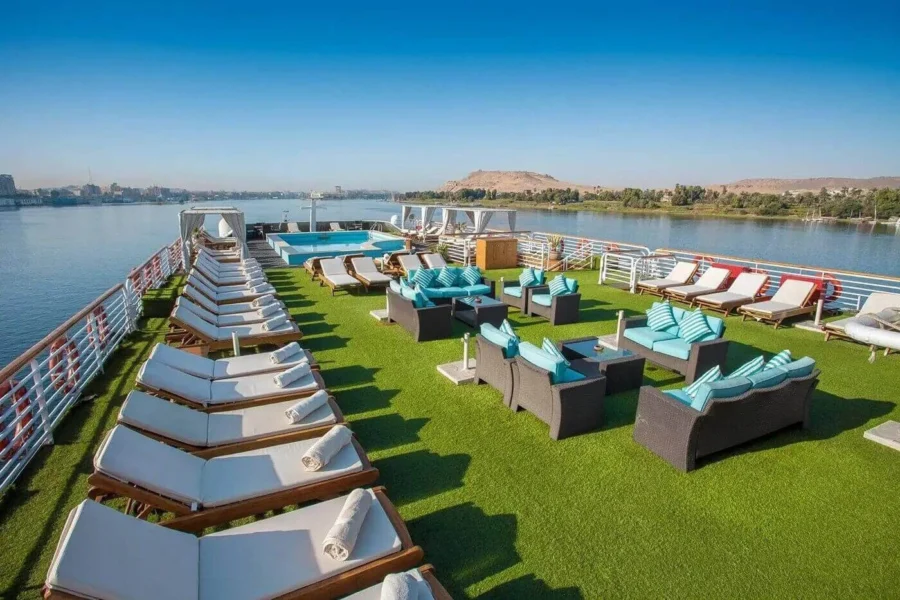
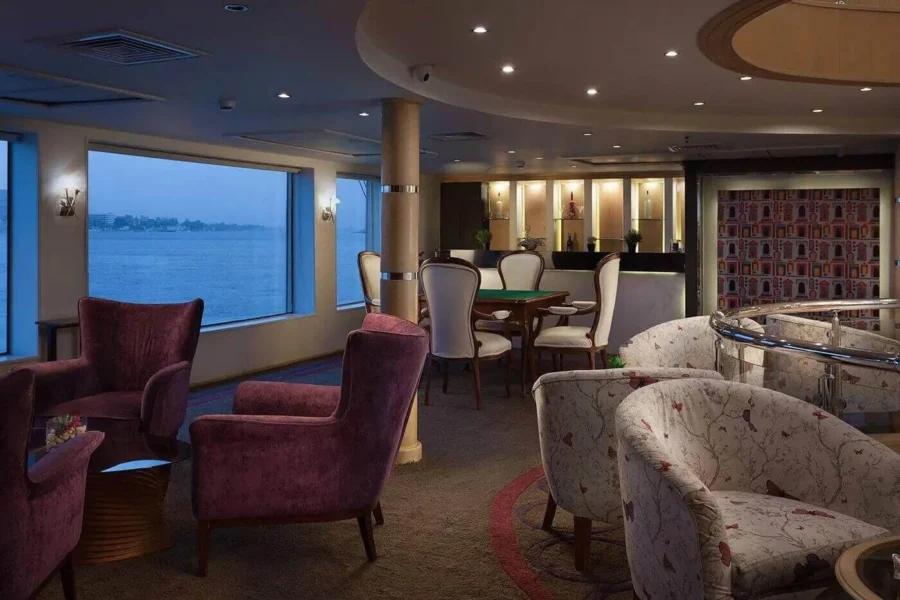
For temples, cover shoulders and knees in light cotton or linen and wear closed shoes. On deck, anything you would wear by a pool. For dinner, smart casual is enough on every ship — no ship on the Nile requires a jacket. Pack one nicer outfit for the galabeya night and buy the galabeya in Esna.
Loose, light-coloured, breathable clothing that covers shoulders and knees at temples; smart-casual for dinner; and a warm layer for the deck at night in every season. Egypt is not strict about what visitors wear, but the temples have a real dress code, the sun is unforgiving, and the ship’s air conditioning is more aggressive than anyone expects.
The mistake almost everybody makes is packing for the heat and forgetting the cold. In January the sun deck after dinner is 8°C on open water. We watch people borrow blankets on night two every single winter.
Key takeaways
Temples: cover shoulders and knees, light cotton or linen, closed shoes.
Deck: anything you would wear by a pool.
Dinner: smart casual on every ship — no ship on the Nile needs a jacket.
One nicer outfit is enough for the whole cruise.
The temple dress code, plainly
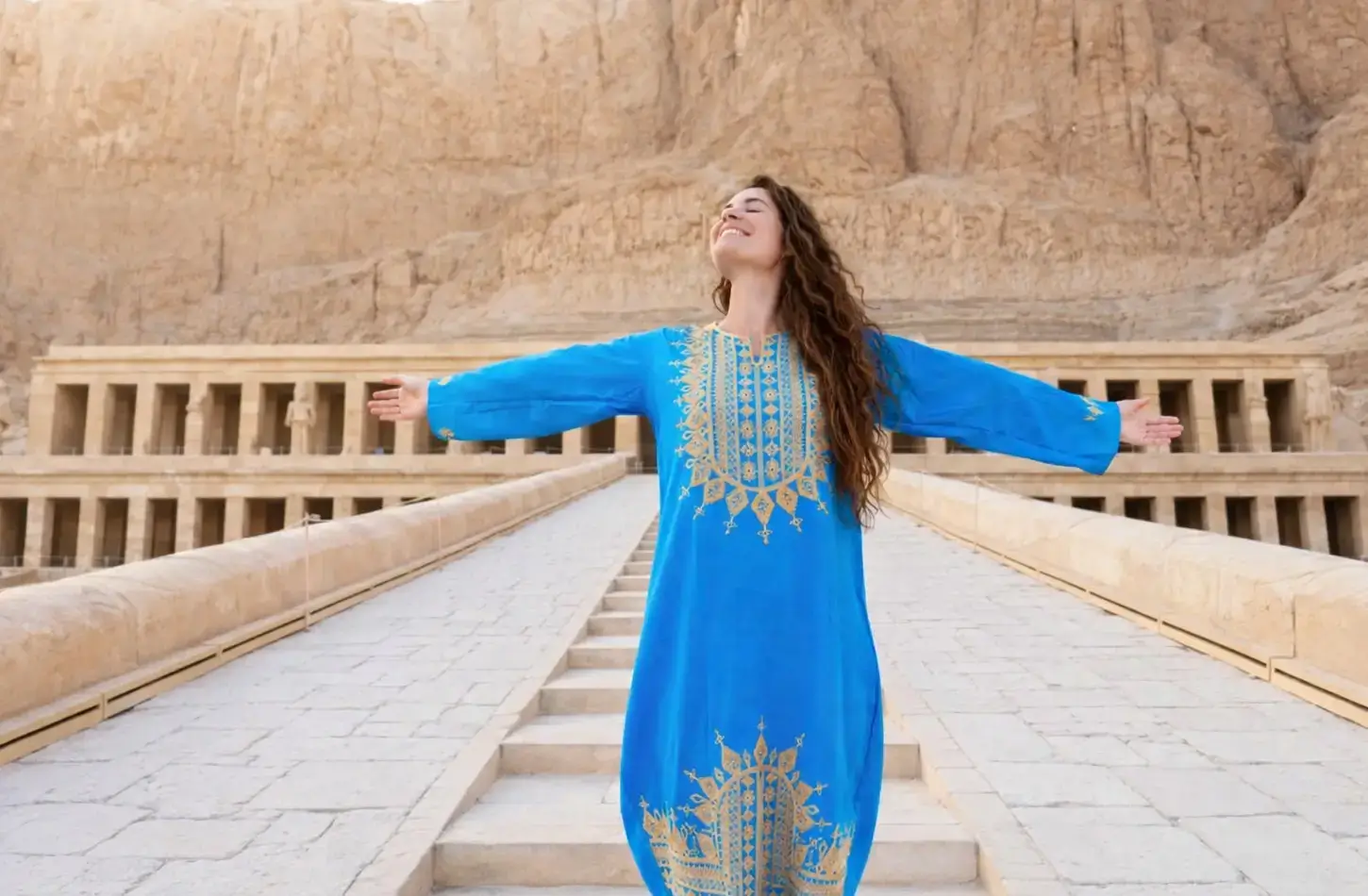
Shoulders and knees covered. That is the whole rule, and it applies to men as well as women.
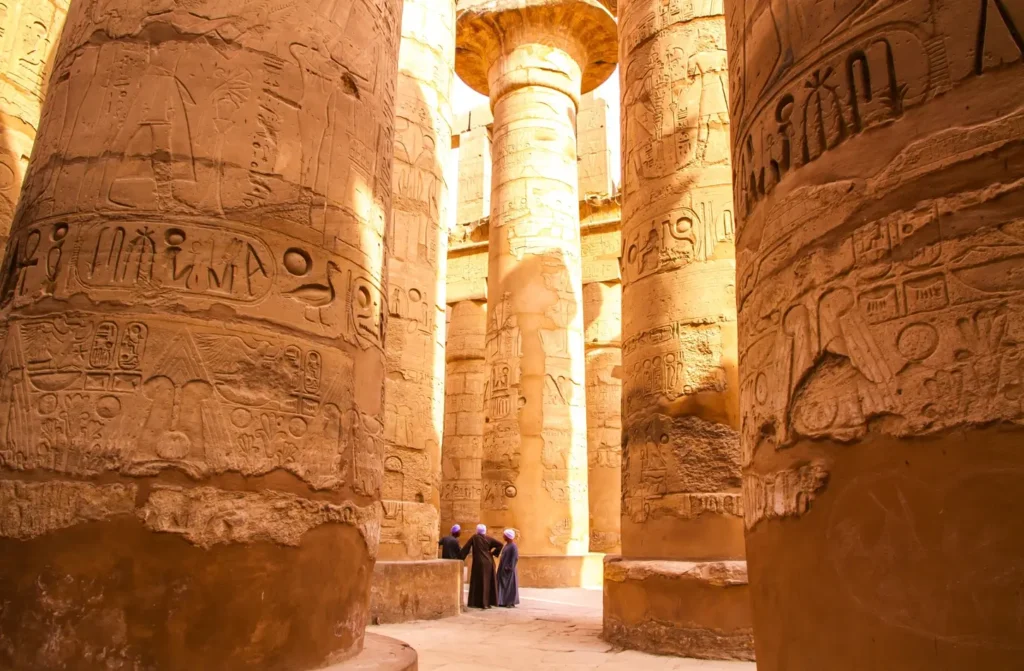
In practice nobody is turned away at Karnak for a bare shoulder, and you will see visitors in vest tops. But you will feel conspicuous, guides notice, and at working religious sites — mosques, Coptic churches, the Nubian villages — it stops being a matter of feeling and becomes a matter of access. Women should carry a scarf for hair covering at mosques.
What to avoid: crop tops, short shorts, plunging necklines, anything sheer. What works: linen trousers, a long skirt, a loose shirt with sleeves.
Men in shorts is fine at the temples and normal on the ship. Long trousers at dinner is the convention on most boats.
Full sun and no shade for two hours — this is what the covering clothes are actually for.
What to wear by time of day
When
Wear
Early excursion
Light layers — it is genuinely cool before 8am
Temples, midday
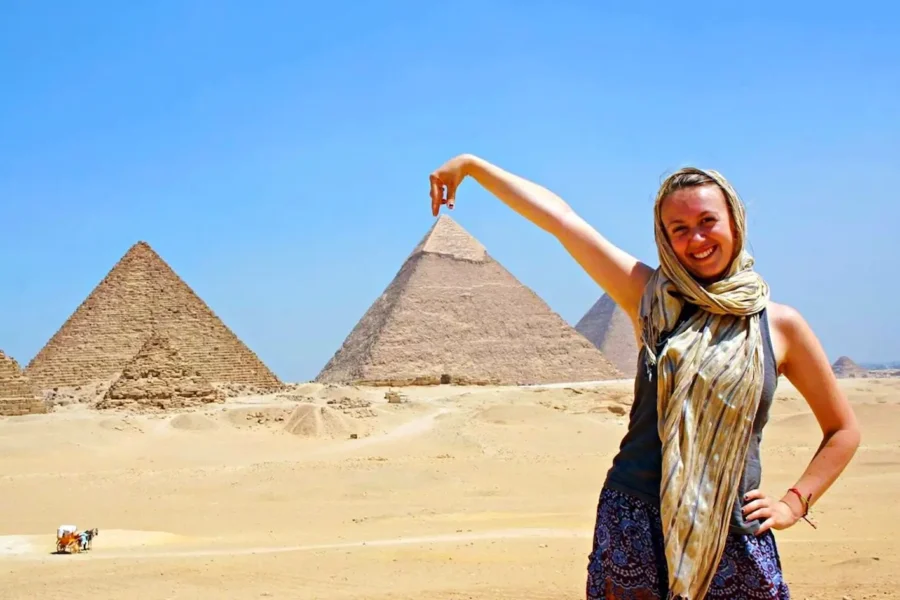
Loose long sleeves, wide-brim hat, closed shoes
Sailing afternoon
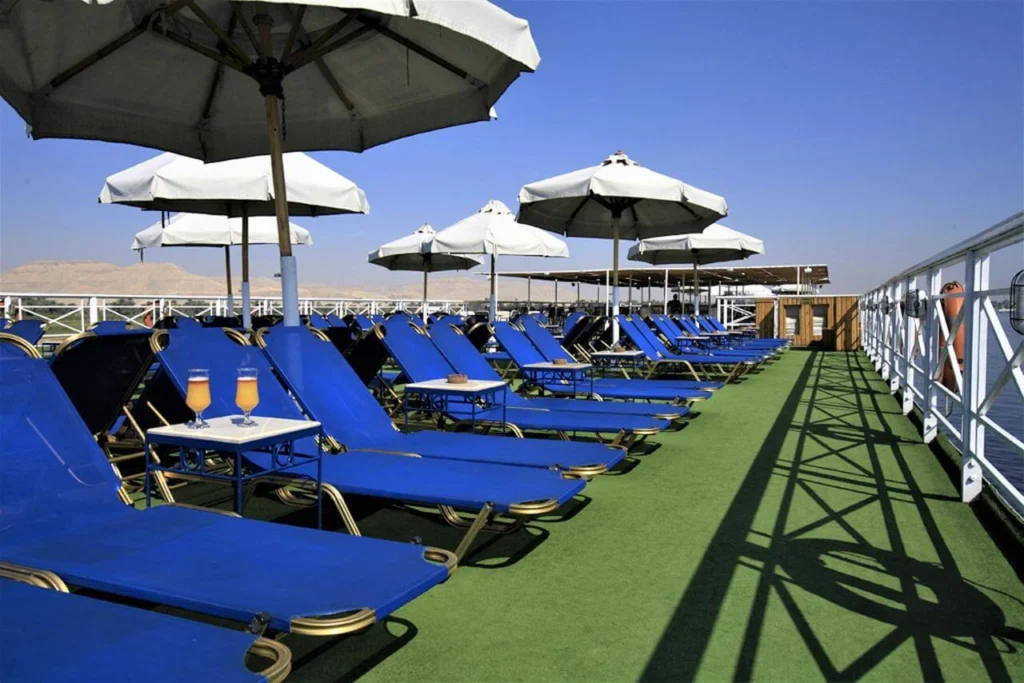
Swimwear, cover-up, sandals
Dinner
Smart-casual — collared shirt, dress or blouse
Deck at night
Fleece or jacket, scarf. Every season.
Cover up to stay cool
This feels wrong and it is correct: in Egyptian sun, loose long sleeves are cooler than bare skin.
The humidity in Luxor and Aswan is very low, so sweat evaporates fast and a loose cotton or linen layer holds that cooling effect against you while blocking direct radiation. Bare arms at Kom Ombo at eleven in the morning burn and dehydrate you faster.
Colour matters too. Light colours reflect; they also hide the fine limestone dust that gets on everything at the Valley of the Kings. Dark clothing shows dust badly and absorbs heat.
A scarf is the most useful thing in the bag. Sun cover at Karnak, shoulders in a mosque, and a blanket on the deck after dark.
Shoes
Get this right and it changes your trip. Temple floors are uneven stone, tomb ramps are steep and often slippery with dust, and Karnak alone is a two-hour walk.
Bring closed walking shoes with grip. Trainers are fine. Hiking boots are overkill. Sandals are for the boat, not for the Valley of the Kings — the dust gets in and the stone is rough.
A second pair matters more than people think, because the first pair will be full of sand by day two and there is nowhere to dry them properly.
For dinner, anything neat. Nobody dresses up much.
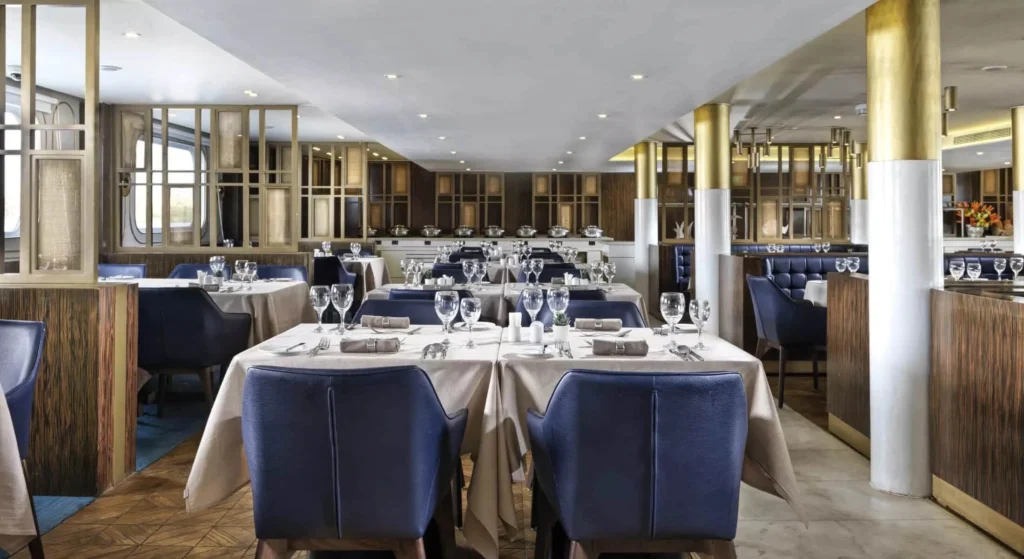
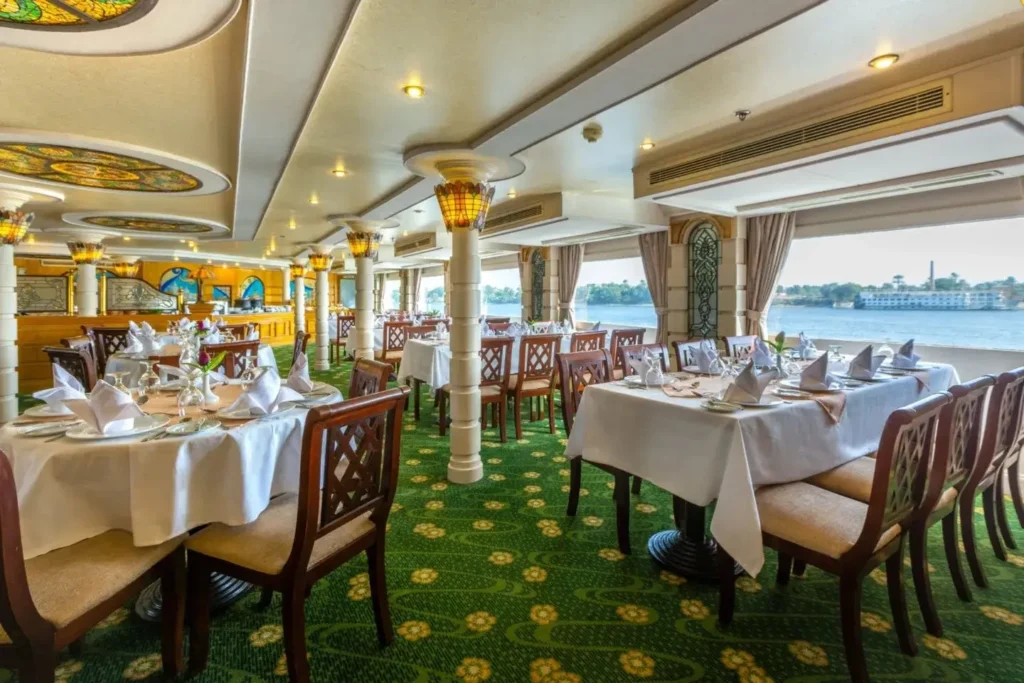
Dinner on a Nile ship is smart casual. Nobody will be wearing a tie.
Season by season
November to February
Days around 23 to 29°C — shirt weather. Nights drop to 6 to 9°C, and that is the number people ignore.
Pack a real jacket, not a light cardigan. A scarf that works for warmth and for shoulder cover at temples earns its space. Long trousers most days.
March, April and October
Days 30 to 35°C. Light clothing, but bring one warm layer for evenings — the desert still drops at night.
This is khamsin season, the hot dusty wind from the south. It arrives for a day or two at a time between March and May. Sunglasses stop being optional and a scarf you can pull over your face is genuinely useful.
May to September
39 to 42°C. Everything loose, everything light-coloured, everything long-sleeved.
Excursions run at 5:30 or 6am and you are back on board by ten, so you are dressing for a cool dawn and a brutal mid-morning in the same outfit. Layers you can shed. A hat is not optional — a wide brim, not a cap, because it is the back of your neck that burns.
Ironically you still want a light layer indoors: ships run the air conditioning hard in summer and the dining room is cold.
Dinner and gala nights
Smart-casual is the standard across the fleet. For men, a collared shirt and chinos. For women, a dress, or a blouse with a skirt or trousers.
Nobody wears black tie. On gala nights over Christmas and New Year people dress up a little more, but “a little more” means a nicer shirt, not a dinner jacket. One good outfit is enough for a four-night cruise — see our Christmas cruise guide if you are travelling over the holidays.
Most ships also run a galabeya night, where the crew produce traditional Egyptian dress for anyone who wants to join in. You do not need to buy anything in advance; they lend them, and the ones for sale in Luxor souks are cheap if you would rather have your own.
A packing list that actually fits
For a four-night cruise, per person. Laundry on board means you do not need more than this.
Item
How many
Note
Loose long-sleeved shirts
3
Light colours, cotton or linen
T-shirts
2
For the deck, not the temples
Light trousers or long skirt
2
One doubles for dinner
Shorts
1
Ship only
Dinner outfit
1
Smart-casual, that is all
Swimwear
1–2
Every ship has a pool
Warm jacket or fleece
1
Every season, no exceptions
Large scarf or shawl
1–2
The most useful item you own here
Closed walking shoes
2 pairs
One will be full of dust
Sandals
1
Deck and dinner
Wide-brim hat
1
Not a cap
How modesty is actually read here
Worth saying clearly, because guidance on this tends to be either alarmist or dismissive.
Luxor and Aswan are tourist towns and locals see visitors dressed every possible way. Nobody will confront you. What changes with what you wear is subtler: how much attention you attract from vendors, how comfortable you feel walking through a market, and how you are received in a village or a shop rather than a hotel.
Egyptian women in these towns dress conservatively — long sleeves, ankle-length, most with hair covered. You are not expected to match that. Covering shoulders and knees puts you comfortably inside the range of what visitors normally wear, and that is genuinely all it takes.
The place where it stops being optional is religious buildings still in use. At a mosque, women cover hair, everyone removes shoes, and shorts are not acceptable for anyone. Coptic churches are less strict but shoulders and knees still apply.
Men: the only real note is that very short shorts read as beachwear off the boat. Knee-length is unremarkable everywhere.
Swimwear belongs on the sun deck and nowhere else on board — a cover-up between cabin and pool is the norm.
What to leave at home
Heels. Nowhere on this trip rewards them.
Formal wear. No ship on the Nile requires it.
More than one outfit per day. Laundry exists on board.
Dark, heavy fabrics. Hot, and they show every speck of dust.
Brand-new shoes. Karnak is not the place to break them in.
The things people forget
Not clothing exactly, but they belong in the same suitcase decision.
A scarf or shawl. Shoulder cover, sun protection, dust mask, and warmth at night. The most useful single item you can pack.
A wide-brim hat that will survive being crushed in a day bag.
Sunglasses with real UV protection. The glare off pale limestone is severe.
A small day bag for water, sunscreen and your camera. You carry it for two hours at a time.
High-factor sunscreen. Available in Egypt but expensive and the range is limited.
Swimwear. Every ship has a pool and people forget.
Dressing for the tombs specifically
The Valley of the Kings deserves its own note, because conditions inside are nothing like conditions outside.
The tombs are dug deep into limestone and they hold the previous night’s temperature well into the morning. In summer you go from 35°C in the valley to something markedly cooler within twenty metres of descending — pleasant, and enough of a change that a thin layer in your day bag is worth carrying.
They are also dusty, unlit in places beyond low-level lighting, and the ramps are steep with a handrail that is not always there. Grip matters more than in any temple. Several tombs involve a descent of 60 to 100 metres of corridor and the same climb back out.
What not to bring in: flash photography is prohibited and enforced, tripods need permission, and large backpacks are sometimes refused at the entrance. A small shoulder bag avoids the argument.
Dinner is smart-casual on almost every ship: a collared shirt or a dress, and no ship on the river requires black tie.
Laundry on board
Every ship offers it, priced per item — roughly $2 to $4 for a shirt. Turnaround is usually same-day if you hand it in at breakfast.
This is why you do not need eight outfits for four nights. Four or five changes covers it comfortably, and travelling light matters when you are moving between a Cairo hotel, a domestic flight and a cabin with one narrow wardrobe.
Loose, light-coloured, breathable clothing covering shoulders and knees for temples, swimwear for the deck, smart-casual for dinner, and a warm jacket for evenings on deck in any season.
Is there a dress code at Egyptian temples?
Shoulders and knees covered, for men and women. It is rarely enforced at major temples but matters at mosques, churches and villages. Carry a scarf.
Can women wear shorts in Luxor and Aswan?
On the ship, yes. At temples and in town, knee-length or longer is far more comfortable socially and draws much less attention.
Is there a dress code for dinner on a Nile cruise?
Smart-casual. A collared shirt and trousers for men, a dress or blouse for women. No ship on the Nile requires formal wear.
What shoes should I bring?
Closed walking shoes with grip for temples and tombs, plus sandals for the boat. Bring two pairs — the first will be full of dust by day two.
How cold does it get at night?
December and January nights drop to 6 to 9°C, and the open sun deck feels colder. Bring a proper jacket, not just a cardigan.
Should I cover up in summer even though it’s hot?
Yes. Loose long sleeves in light colours are cooler than bare skin in dry desert heat, and they prevent burning during pre-dawn excursions that run into mid-morning.
Do I need to bring a galabeya?
No. Ships that run a galabeya night lend them. If you want your own, they cost very little in the Luxor souk.
Still unsure what to bring?
Send us your dates and a rough budget — a specialist replies with three ships across categories, live availability and a written price. No online payment.
Written byMagdy Fattouh38 guides published on this site
Magdy Fattouh is a Cairo University history graduate and the writer behind the guides on this site. Over 13 years he has researched and written about Egypt's history, its monuments and how to travel to them — from the pharaohs and the temples to month-by-month planning, ship comparisons and day-by-day itineraries. He speaks English and Arabic, and reviews every guide here for accuracy before it is published.
Read more by Magdy Fattouh →
The tourist visa is $30 on arrival or online, valid 30 days. Bring clean US dollars in small denominations, and get Egyptian pounds for everything minor. Plus SIMs,…
We use essential cookies to make this site work. With your permission we also use Google Analytics cookies to understand how the site is used, so we can improve it. We never use cookies for advertising. Cookie Policy
Strictly necessaryRemember your cookie choice and keep the site secure. Always on.
Always on
Google Analytics: which pages are visited and how people find us. No personal profile, no advertising.


 Practical