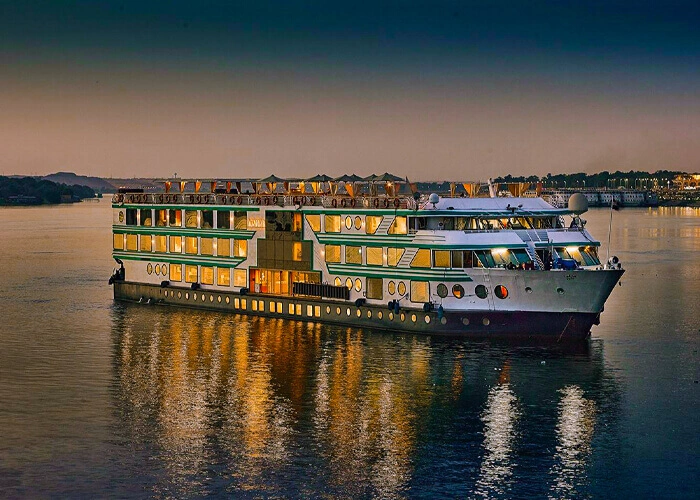
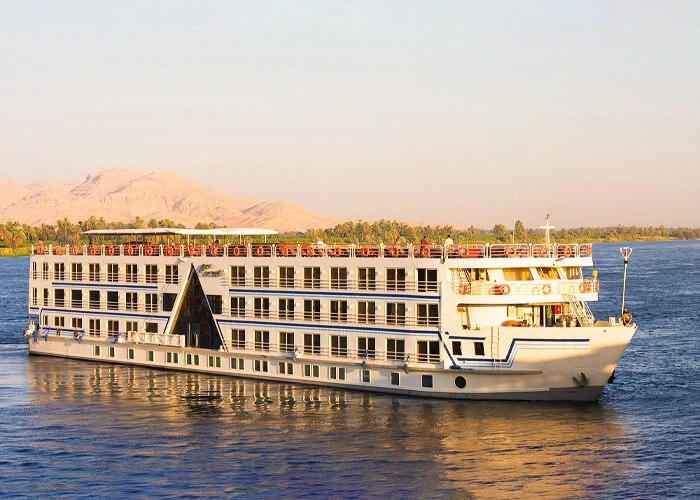
October to April is the comfortable season, with daytime highs of 20–30°C. February, March and November are the best balance of weather, crowds and price. December and January are the busiest and dearest, especially Christmas and New Year. May to September is 35–42°C, which is genuinely hot, but prices fall by roughly half and the ships are quiet.
The best time for a Nile cruise is October to April, when daily highs in Luxor sit between 23°C and 35°C. November and March are the two best months overall — warm enough for the deck, cool enough for the temples, and cheaper and quieter than the December to February peak. Summer is half the price and genuinely punishing.
That is the short answer. The longer answer is that “best” depends on whether you are optimising for weather, for crowds, or for price, because you cannot have all three. Here is every month, honestly.
Key takeaways
October to April is the comfortable season; February, March and November are the sweet spot.
December and January are the busiest and most expensive weeks of the year.
May to September reaches 35–42°C, and prices fall by roughly half.
The temples are open all year — only the heat and the price change.
Nile cruise weather at a glance
Month
Luxor avg high
Crowds
Price
January
23°C / 73°F
Very high
High
February
25°C / 77°F
High
High
March
30°C / 86°F
High
High
April
35°C / 95°F
Medium
Medium
May
39°C / 102°F
Low
Low
June
41°C / 106°F
Very low
Lowest
July
42°C / 108°F
Very low
Lowest
August
41°C / 106°F
Low
Low
September
39°C / 102°F
Low
Low
October
35°C / 95°F
Medium
Medium
November
29°C / 84°F
High
High
December
24°C / 75°F
Peak
Peak
Average daily maximum. Aswan runs 1 to 2 degrees hotter than Luxor year-round. Nights in December and January drop to 6–9°C, which surprises people.
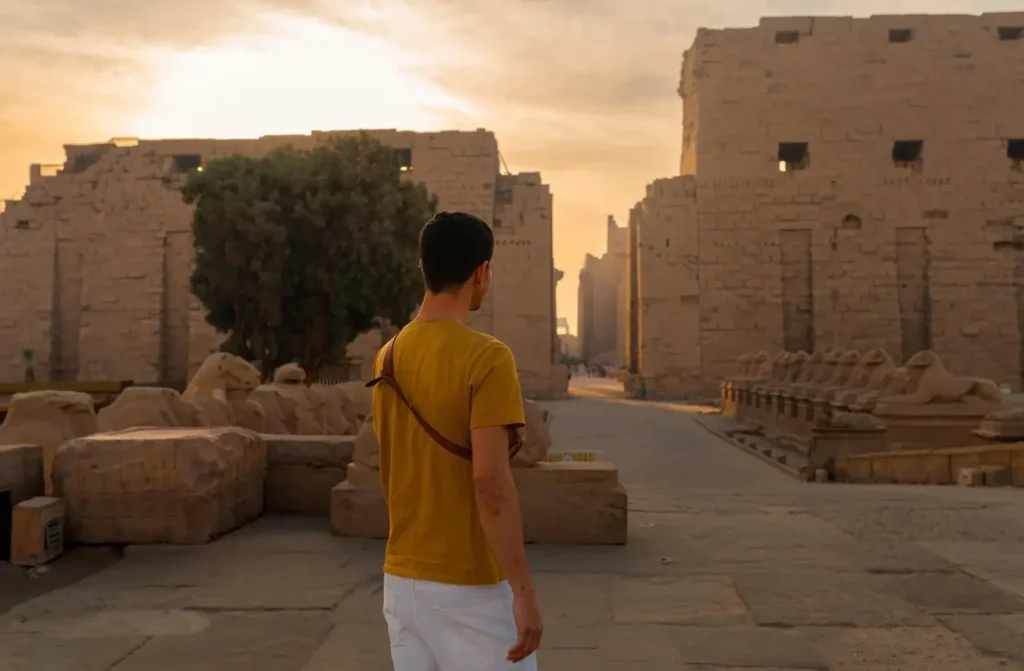
Winter mornings at Karnak are cool enough to walk the whole complex; in August you want to be finished by nine.
How Egypt’s climate shapes the cruise day
Before the month-by-month, it helps to understand what the heat actually does to an itinerary, because it is not simply a matter of comfort.
Luxor and Aswan sit in genuine desert. There is essentially no rain — both cities average under 5mm a year — and almost no humidity, which is why 39°C here feels different to 33°C somewhere coastal. Shade works. Water works. But the sun is direct and most of what you have come to see has no roof.
Temple sites are open, stone, and reflective. The Valley of the Kings sits in a limestone bowl that holds heat like an oven; by eleven in the morning in May the air coming off the rock is hotter than the air temperature. Karnak takes two hours to walk properly and there is shade in perhaps a fifth of it.
So operators shift the clock rather than the itinerary. In winter, excursions leave around eight and you are back for a late lunch. In summer, they leave at 5:30 or 6, and by ten you are on board with the day ahead of you. You see the same things either way. What changes is how much of the day is yours.
The other seasonal factor is the khamsin — hot, sand-carrying winds that blow up from the south, mostly between March and May. They arrive for a day or two at a time, drop visibility, and make outdoor time unpleasant. They are not common enough to plan around, but they are worth knowing about so that one hazy afternoon does not feel like bad luck you were not warned about.
January
The coolest month and the busiest. Daytime highs around 23°C make temple mornings genuinely comfortable — you can stand in the sun at Karnak at eleven in the morning without suffering, which is not true for eight months of the year.
The catch is everyone else has worked this out. Boats run full, temples are busy from nine onwards, and prices stay elevated through the whole month, though they drop noticeably after about the 6th once the New Year block clears.
Bring layers. Nights fall to 7 or 8°C and the sun deck at dinner is cold. Every year we watch people who packed only for “Egypt” borrow a blanket on night two.
Book if: you want the most comfortable sightseeing weather of the year and you accept crowds.
Shoulder season is the value answer. Late October and early April give you almost the same weather as February at noticeably lower prices.
February
January’s weather with slightly fewer people. Highs around 25°C, clear skies, and the light is superb for photography — low sun angle, no haze.
Two things make February distinctive. The Abu Simbel Sun Festival on 22 February, when sunlight penetrates the length of the temple to illuminate the inner sanctuary — a real spectacle, and one that draws a serious crowd, so book that date months out. And Ramadan, which in 2027 falls roughly across February into early March.
February is also when the khamsin wind occasionally begins — hot, dusty southerlies that can blow for a day or two. Uncommon this early, but not unheard of.
Book if: you want January’s weather with a little more breathing room.
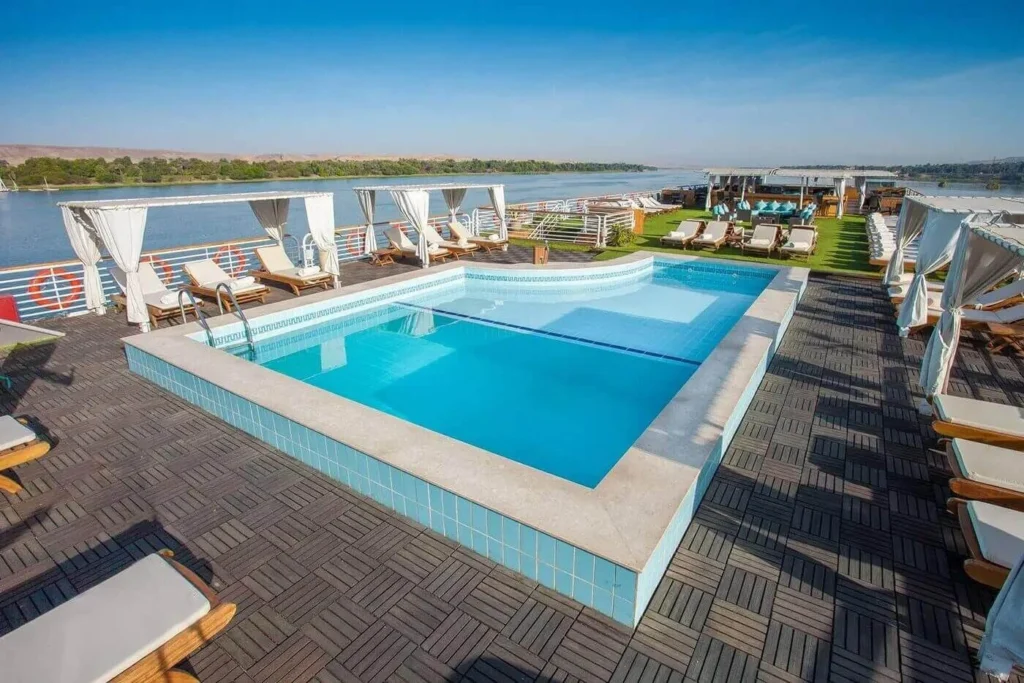
The pool is the reason summer sailings are not as unbearable as the forecast suggests — most of the day is spent on board.
March
One of the two best months, and our pick if you cannot travel in November.
Highs around 30°C is close to ideal for this trip. Warm enough to swim and to sit on deck after dinner, cool enough that a two-hour walk around Karnak does not become an endurance test. The winter crowds thin from mid-month.
Watch for Easter. When Easter falls in late March, the week around it prices like Christmas and books out like it too. Check the date before you commit.
The khamsin is more likely now than in February — expect the possibility of one dusty, hazy day. It passes.
Book if: you want the best available balance of weather, crowds and price.
April
The month where the heat announces itself. Highs reach 35°C, and while that is manageable, it changes the rhythm of the day. Excursions start earlier and afternoons become deck-and-shade time rather than exploring time.
The upside is real: crowds drop to medium, prices come off the winter peak, and the Nile-side scenery is at its greenest.
Early April behaves like March. Late April behaves like May. If you have flexibility within the month, take the first half.
Book if: you want shoulder-season prices and can handle a hot afternoon.
May
39°C. This is where the season genuinely turns.
Ships are half empty and prices fall 30 to 40 percent below the winter rate. Temples that had 600 people in them in January have 80. If you have seen photographs of a deserted Edfu and wondered how, this is how.
The trade is that midday is not usable. Excursions run from 6 or 7am and you are back on board by eleven. It is dry heat, which helps more than people expect, and every interior space you use is air conditioned. But you will not be strolling anywhere at two in the afternoon.
Book if: price and quiet matter more to you than comfort, and you are disciplined about early starts.
June
41°C average, with individual days past 45. The emptiest and cheapest end of the year alongside July.
Cruises still operate normally and the ships handle it — this is what they are built for. Excursions move to 5:30 or 6am starts, which is a genuinely lovely time to be at a temple. You get the Valley of the Kings almost to yourself, in soft light, with the air still cool from the night.
Then you spend the rest of the day on board. Whether that is a bargain or a compromise depends entirely on your temperament.
Older travellers and anyone with a heart or respiratory condition should think carefully about June through August. This is not a formality.
Book if: you want the lowest price of the year and empty sites.
July
The hottest month at 42°C, and the pattern is identical to June — pre-dawn excursions, afternoons inside, prices at the floor.
One practical note specific to high summer: the Nile is at its lowest before the annual release from the High Dam, and a few of the smaller vessels adjust their itineraries around water levels. Larger ships are unaffected. Ask if you are booking a dahabiya.
July also brings European school holidays, so while overall numbers are low, the ships that do sail carry more families than usual.
Book if: you are heat-tolerant, price-driven, and only free in July.
August
Still 41°C, but numbers begin creeping back as the summer holiday crowd arrives. Prices remain low.
August is the least interesting month to recommend — it has July’s heat without July’s absolute emptiness. If you can move to September you get almost the same price and two degrees less.
One thing in its favour: August is when you will find the newest, best-maintained ships discounted to levels that would be unthinkable in December. If you have always wanted a particular boat, this is the month it becomes affordable.
Book if: the dates are fixed and you want a better ship than your winter budget would buy.
September
The turn begins. Still 39°C in the first half, noticeably easier by the last week. Crowds are low, prices are low, and the season is about to change under your feet.
Late September is quietly one of the better-value windows in the calendar — you get October’s shoulder conditions at August’s prices, because the market has not caught up yet. We book a lot of returning travellers into the last ten days of September for exactly this reason.
Book if: you want the best value-to-comfort ratio of the year and can travel late in the month.
October
The season properly opens. 35°C, dropping through the month, with crowds building from medium toward high by the end.
The Abu Simbel Sun Festival falls again on 22 October, the second of its two annual alignments and generally the less crowded of the pair.
Early October still feels like late summer. By the last week you are into what most people picture when they imagine Egypt — warm days, cool evenings, everything open, everything working.
Book if: you want the start of the good weather before winter pricing arrives.
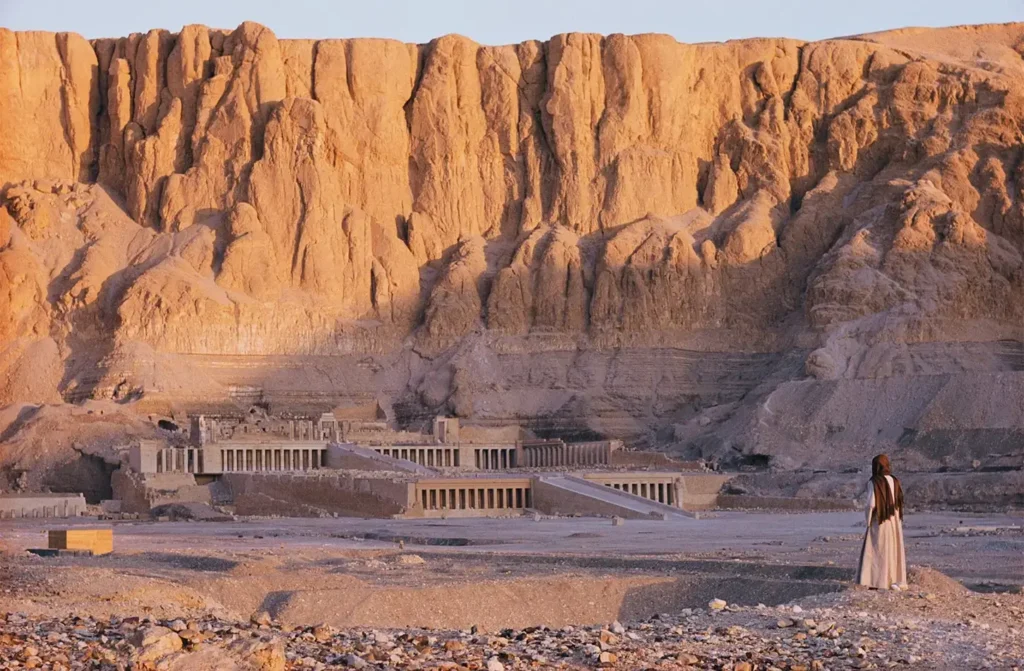
Early light on the west bank in winter: the same site at 2pm in July is a different experience entirely.
November
Our pick for the best month of the year, and it is not close.
29°C is close to perfect for this specific trip. You can walk a temple at midday. You can sit on deck at nine at night in a shirt. The light is clean, the humidity is negligible, and the khamsin season is over.
Crowds are high but not yet at the December crush, and prices, while firm, are below the Christmas peak. Boats are fully staffed and fully maintained after the summer refit period.
The only real argument against November is that plenty of other people have reached the same conclusion. Book three to four months ahead for the ship you actually want.
Book if: you want the best all-round month and you can plan ahead.
December
Two completely different months wearing the same name.
Until about the 18th: excellent. 24°C, manageable crowds, reasonable prices. Genuinely one of the better windows in the year and consistently underrated.
21 December to 5 January: the peak of the peak. Prices rise 40 to 70 percent, the best ships sell out four to six months ahead, and the temples are as busy as they get. Christmas and New Year on the Nile is a wonderful thing and it costs accordingly.
Nights are cold — 6 to 9°C — so pack properly regardless of which half you choose.
Book if: you want early-December value, or you specifically want Christmas and have budgeted for it.
The three questions that decide your month
Rather than reading twelve sections again, answer these.
Is heat a real problem for you? If yes, you have November through March and nothing else. Do not let a low price talk you into June.
Is price the binding constraint? If yes, late September and early October give you the most comfort per dollar. May through August is cheaper still but the trade is severe.
Do crowds bother you more than weather? If yes, May and late September are your months, and you should also be looking at a smaller ship regardless of when you sail. A 40-passenger boat in January is quieter than a 200-passenger boat in May.
Cruising during Ramadan
Ramadan moves roughly eleven days earlier each year; in 2027 it falls approximately from early February into early March. Confirm the dates before planning around it, as they depend on the lunar sighting.
Nile cruises operate normally. Your ship serves all meals as usual, since it caters to visitors. Sites and temples keep normal hours, though some close slightly earlier.
What changes is ashore. Restaurants in Luxor and Aswan may not open until sunset, and the towns are quiet during the day and lively late into the night. Some crew are fasting, which they handle with more grace than most of us would.
Visitor numbers drop during Ramadan, which makes it one of the quieter windows in an otherwise busy season. If you want winter weather without winter crowds, this is the gap.
The Abu Simbel Sun Festival
Twice a year, on 22 February and 22 October, sunrise light travels 60 metres into the Great Temple at Abu Simbel and illuminates three of the four statues in the inner sanctuary. Ptah, the god associated with the underworld, stays in shadow. The alignment was built deliberately more than three thousand years ago and survived the temple being cut apart and moved in the 1960s.
It is worth seeing. It is also extremely crowded, requires a start around 3am from Aswan, and the actual event lasts about twenty minutes.
If you want it, book the cruise and the excursion four to six months ahead. October is the quieter of the two dates.
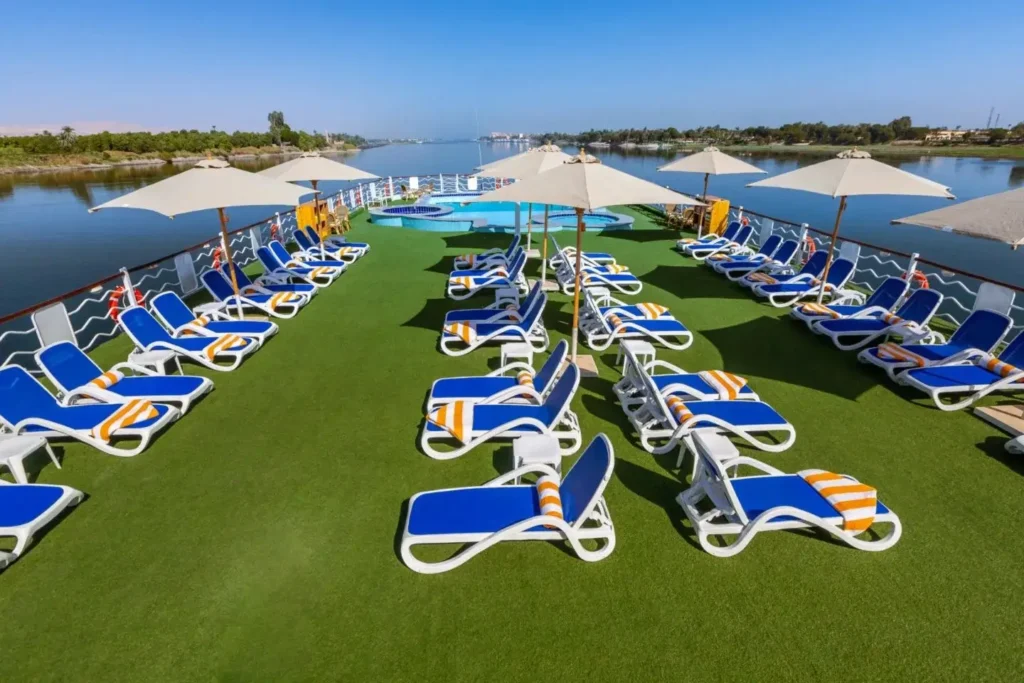
Between October and April the sun deck is usable all day. In high summer it is a dawn-and-dusk place.
What to pack changes more than you would think
The same trip in January and in June needs meaningfully different luggage, and getting this wrong is the most common avoidable discomfort we see.
November to February. Layers. Daytime is shirt weather; evenings on the deck genuinely need a fleece or a jacket, and January nights at 7°C on open water with a breeze feel colder than the number suggests. A scarf does double duty — warmth at night, shoulder cover at temples.
March to April, and October. Light clothing plus one warm layer. Sun protection becomes serious rather than optional. A wide-brimmed hat, not a cap — the back of your neck is what burns.
May to September. Loose, light-coloured, long-sleeved cotton or linen. Counterintuitive but correct: covering up in direct sun is cooler than exposing skin. Electrolyte sachets are more useful than you expect. And bring a second pair of shoes, because the first pair will be full of sand.
Year-round, regardless of month: temples require covered shoulders and knees for everyone, and the ship’s air conditioning is aggressive at night in every season. Something with sleeves is never wasted — the full what to wear guide covers it.
A note on booking windows by season
When you book matters almost as much as when you sail, and the lead times are not intuitive.
Sailing period
Book by
Why
21 Dec – 5 Jan
4–6 months ahead
Best ships sell out first; late cabins cost more, not less
Easter week
4–5 months ahead
Compressed demand into seven days
November, March
3–4 months ahead
Highest demand outside the holidays
Oct, Feb, Apr
6–10 weeks ahead
Good availability, firm prices
May – September
3–6 weeks ahead
Late deals are real in this window
The pattern worth internalising: in low season, waiting saves you money. In high season, waiting costs you money and choice. Christmas is the clearest case — the last cabins available in mid-December are almost always the most expensive ones on the boat, because the reasonable ones went in July.
Our honest pick
November first, March second. Both give you weather that lets you actually use the day, crowds that are busy rather than overwhelming, and prices below the Christmas spike.
If those are closed to you, take late September for value or early December for a quieter version of the peak.
And if someone offers you a summer cruise at half price and you are the sort of person who is genuinely fine in heat — take it, start early, and enjoy having Edfu to yourself. Or browse our Egypt packages and tell us your dates.
Frequently asked questions
What is the best month for a Nile cruise?
November, with March a close second. Luxor averages 29°C in November — warm enough for the deck, cool enough for temples — with crowds and prices below the December peak.
What is the worst time for a Nile cruise?
June through August, when Luxor averages 41 to 42°C and midday sightseeing is not practical. Cruises still run, with excursions moved to before dawn, and prices drop 30 to 50 percent.
Can you do a Nile cruise in summer?
Yes. Ships operate year-round and are fully air conditioned. Excursions start at 5:30 or 6am and you spend the afternoon on board. Sites are close to empty and prices are the lowest of the year.
When is the cheapest time for a Nile cruise?
June and July, when prices sit 30 to 50 percent below average. For a better balance, late September offers near-shoulder conditions at close to summer prices.
Is December a good time for a Nile cruise?
The first three weeks are excellent — 24°C and reasonable prices. From 21 December to 5 January, prices rise 40 to 70 percent and the best ships sell out months ahead.
How far ahead should I book for November or December?
Three to four months for November. Four to six months for the Christmas and New Year window, which sells out earliest.
Does it rain in Luxor or Aswan?
Almost never. Both cities average well under 5mm of rain a year. You can plan an outdoor trip here with more confidence than almost anywhere on earth.
How cold does it get at night?
December and January nights drop to 6 to 9°C. The sun deck after dinner is genuinely cold in midwinter, and most people underpack for it. Bring a jacket and a scarf.
Know your month? Get ships for those dates
Send us your dates and a rough budget — a specialist replies with three ships across categories, live availability and a written price. No online payment.
Written byMagdy Fattouh38 guides published on this site
Magdy Fattouh is a Cairo University history graduate and the writer behind the guides on this site. Over 13 years he has researched and written about Egypt's history, its monuments and how to travel to them — from the pharaohs and the temples to month-by-month planning, ship comparisons and day-by-day itineraries. He speaks English and Arabic, and reviews every guide here for accuracy before it is published.
Read more by Magdy Fattouh →
Ten to seventeen hours depending on your coast, and a seven to ten hour time shift. Why twelve days beats seven, how to sequence Cairo, and what Thanksgiving…
Five hours direct from London with a one-hour time difference. What ATOL does and does not cover on a direct booking, sterling costs, and why February half term…
We use essential cookies to make this site work. With your permission we also use Google Analytics cookies to understand how the site is used, so we can improve it. We never use cookies for advertising. Cookie Policy
Strictly necessaryRemember your cookie choice and keep the site secure. Always on.
Always on
Google Analytics: which pages are visited and how people find us. No personal profile, no advertising.


 Planning