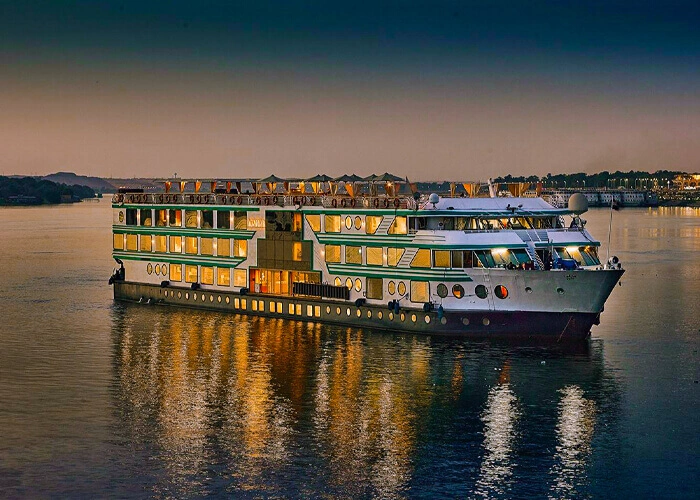
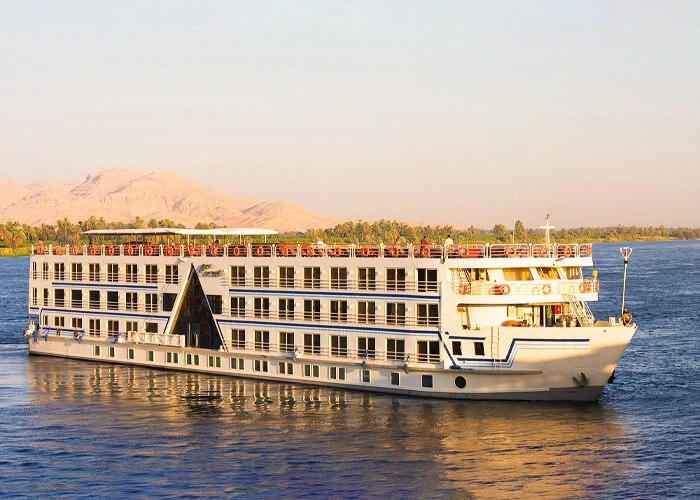
A three-night cruise starts around $285 per person on a standard ship in low season and $480 on a deluxe one; luxury ships start near $960 and dahabiyas near $1,120. Prices roughly double at Christmas. The fare covers the cabin, full board and guided excursions — flights, tips, drinks and optional tombs are not included.
A Nile cruise costs between $485 and $2,700 per person in 2027, depending on the ship and the number of nights. A standard 4-night cruise between Luxor and Aswan runs $600 to $1,200 per person with meals and temple entries included. Budget another $100 to $215 per person for the extras that are not in that headline number.
That range is uselessly wide, which is why nobody quotes it and everybody complains about it. So let us break it into numbers you can actually plan around.
Key takeaways
Three nights starts near $285 per person on a standard ship in low season.
Deluxe starts near $480, luxury near $960, a dahabiya near $1,120.
Christmas and New Year roughly double every one of those figures.
Flights, tips, drinks and optional tombs are never in the fare.
The short answer, by ship class
Nile cruise pricing is driven almost entirely by which boat you are on. Length matters, season matters, but the ship is the big lever.
Ship class
Per person, 4 nights
Roughly per night
Standard (3–4 star)
$485 – $810
$120 – $200
Deluxe (5 star, 80–150 guests)
$600 – $1,200
$150 – $300
Luxury (5 star premium, 40–80 guests)
$1,600 – $2,700
$400 – $675
Dahabiya (8–20 guests)
$1,400 – $3,500+
$350 – $875
Per person sharing a double cabin. Full board and temple entrance fees included. Peak-season dates sit at the top of each band, sometimes above it.
The jump from Deluxe to Luxury is the steepest in Egyptian travel, and it catches people off guard. You can pay four times as much for a boat that visits the identical temples on the identical schedule. What you are buying is space, food quality, guide ratio and the absence of 200 other passengers. Whether that is worth $1,500 is a genuinely personal question and we are not going to pretend there is a right answer.
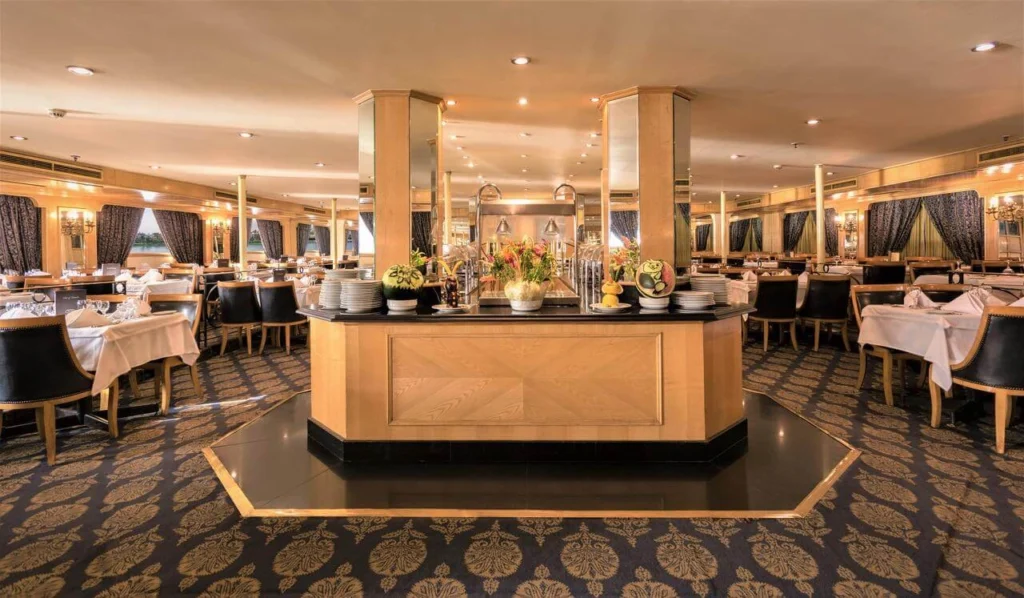
The cabin is most of what separates a $285 ship from a $960 one — the temples and the guide are the same.
What each class actually gets you
Standard, $485 to $810
Older hulls, refurbished at some point in the last decade. Cabins around 15 square metres with a window that does not open. Buffet food that is fine and repetitive. Air conditioning that works, mostly, though this is the class where “mostly” starts doing real work in that sentence.
These boats are perfectly serviceable and thousands of people have a great time on them every season. The honest warning is that below four stars, cleanliness and air conditioning become genuinely variable between ships. On a three-night trip you can absorb that. It is why we do not sell anything under four stars.
Deluxe, $600 to $1,200
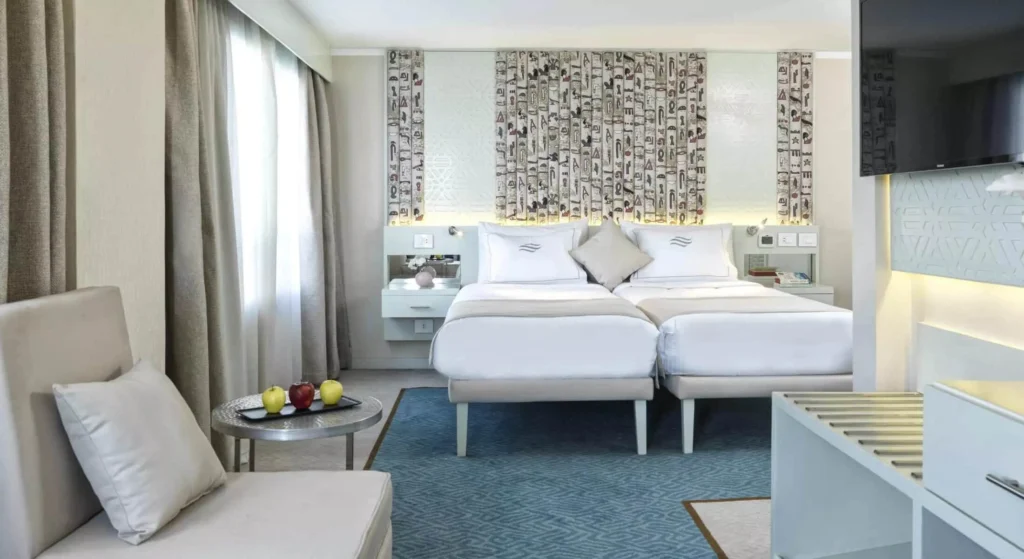
This is where most travellers land, and for good reason. Around 20 square metres, a proper picture window, a pool on the sun deck, a decent buffet with a couple of cooked-to-order stations, and reliable air conditioning. Typically 60 to 75 cabins.
The trade-off is scale. When your ship carries 150 people and three others dock alongside at Edfu, that temple has 600 visitors in it at nine in the morning.
Luxury, $1,600 to $2,700
Fewer, larger cabins — often 25 to 35 square metres, some with a French balcony. Table service instead of buffet lines for at least one meal a day. Guides working with groups of twelve rather than forty. Better wine, included in more cases.
The real purchase here is the group size. Everything downstream of that — how long you get inside the tomb, whether your guide can answer your specific question, how long the buffet queue is — follows from it.
Dahabiya, $1,400 to $3,500 and up
A different product entirely. Four to ten cabins, eight to twenty guests, two masts, actual sailing. No buffet, no evening entertainment, no belly dancer on night three. The boat anchors beside islands and villages that the big ships physically cannot reach because of draught.
Per night it is the most expensive way to travel the Nile. Per experience, a lot of people who have done both say it is the only way they would do it again. It is not for everyone — if you want a gym, a spa and a choice of three restaurants, you will be bored by day two.
How the number of nights changes the price
Roughly linear, with one exception.
Length
Route
Deluxe ship, per person
3 nights
Aswan → Luxor
$450 – $900
4 nights
Luxor → Aswan
$600 – $1,200
5 nights
Either, with extra port time
$750 – $1,450
7 nights
Round trip
$980 – $1,900
The exception is the 7-night round trip. It looks like good value per night, and mathematically it is. But it retraces its own route, so you visit Edfu and Kom Ombo twice, and a meaningful number of passengers find the return leg slow. If you have seven nights, four on the boat plus three on land in Luxor and Aswan will usually show you more.
Budget $8 to $10 per person per day for tips. It is the cost most people forget, and on a four-night cruise for two it is about $80.
Price by season
Egypt has a genuine high and low season and the gap is large — the same cabin on the same ship can differ by 60 percent between August and December.
Period
Demand
Price vs. average
Dec 21 – Jan 5
Peak
+40% to +70%
Oct – Nov, Feb – Apr
High
+10% to +25%
Easter week
Peak
+35% to +55%
Sep, early Oct
Shoulder
Around average
May – Aug
Low
−30% to −50%
Summer is genuinely cheap. It is also genuinely 41°C in Luxor in June, and that is the average daily high, not the peak. Boats handle it — excursions move to 5:30am starts and the ship is air conditioned — but you need to want the trade. Some people do. Empty temples in August are a real thing.
Full board is included on every ship in every category. Drinks other than water are not.
The extras that are not in the headline price
This is where budgets go wrong. None of these are hidden exactly, but they are rarely totalled up for you before you book.
Realistic total for extras: $100 to $215 per person on a four-night cruise, assuming you do Abu Simbel and drink moderately. If you skip Abu Simbel and stick to the water and tea that come with meals, you can hold it under $90.
Drinks deserve a specific warning because it surprises almost everyone. On most Nile cruises, “full board” means three meals with water and sometimes tea or coffee. Soft drinks are extra. Beer is extra. Bottled water in your cabin is often extra. A can of Coke on board runs $2.50 to $4 — not ruinous, but four people over four days adds up faster than you would guess.
A worked example: what a real 4-night trip costs
Two travellers, deluxe 5-star ship, Luxor to Aswan, four nights, travelling in early November. Sharing a double cabin.
Line item
Per person
Two people
Cruise, 4 nights, double cabin
$890
$1,780
Tips (crew envelope + guide)
$56
$112
Abu Simbel by road
$95
$190
Drinks on board
$70
$140
Extra tombs, Valley of the Kings
$22
$44
Egypt visa
$30
$60
Cruise portion total
$1,163
$2,326
Add domestic flights — Cairo to Luxor and Aswan back to Cairo runs roughly $180 to $290 per person combined — and two or three nights in Cairo either side — or take one of our complete Egypt packages — and a trip for two lands somewhere between $3,800 and $5,500 excluding international flights.
That is the number worth planning against. The cruise is usually about half of it.
Why two people pay different prices for the identical cabin
Because Nile cruise pricing is closer to airline pricing than hotel pricing, and almost nobody tells you that.
The same cabin on the same sailing has different rates depending on when it was booked, which agent booked it, whether it came through a wholesale allocation, and how full the boat is that week. Ships release blocks of cabins to operators months ahead at fixed rates. Whatever is unsold ten days out gets discounted hard.
Two practical consequences. First, a quoted price is a real price for that moment, not a fixed tariff — it can move. Second, last-minute bargains genuinely exist in low season and genuinely do not exist between 21 December and 5 January, when boats sell out months ahead and the last cabins are the most expensive, not the cheapest.
The solo traveller problem
Cruise pricing assumes two people in a cabin. Travel alone and you pay a single supplement, typically 50 to 80 percent on top of the per-person rate. On an $890 cabin that is another $445 to $712.
Three ways around it, in order of how well they work:
Ask for a dedicated single cabin. Some ships have a handful, priced far more reasonably than a supplement. They are small and they sell out early, but they exist.
Travel in low season. Supplements often drop to 30 percent or are waived entirely when boats need the occupancy.
Ask about a share. A few operators will pair same-sex solo travellers. Fewer than there used to be, and you have to ask directly, but it is worth the question.
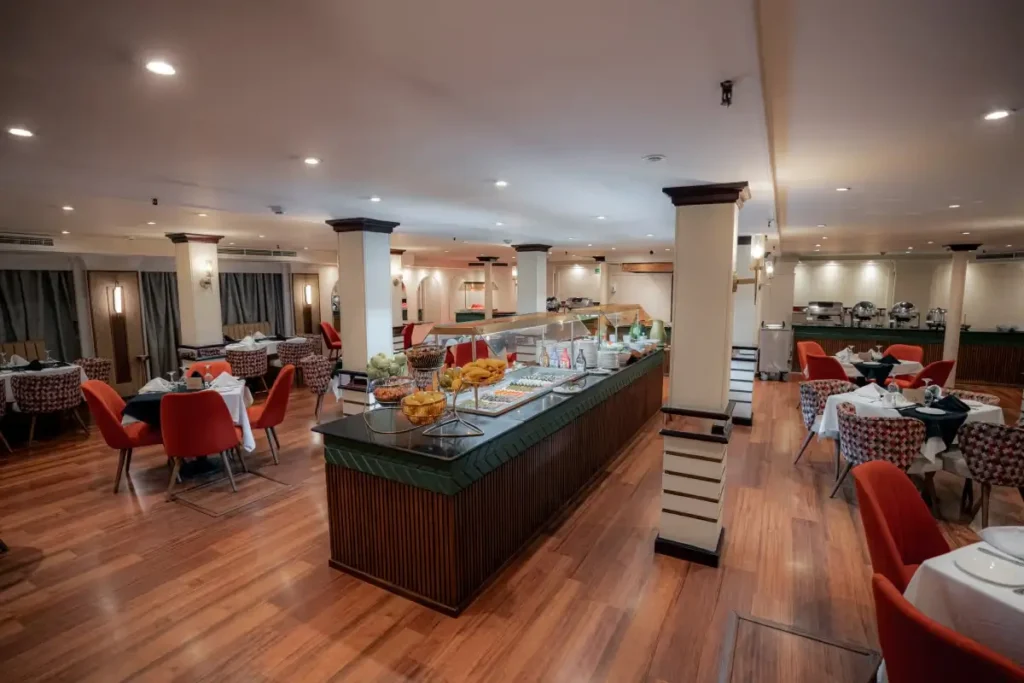
The buffet island is the same on a $520 cruise and a $900 one; what the money buys is space, cabin size and crew ratio.
Does it cost more to book from abroad?
Usually, yes, and understanding why helps you judge whether a price is fair.
A cruise sold by a European or American tour operator carries their margin, their overheads and their currency risk on top of the Egyptian net rate. A cruise sold by an Egyptian operator carries one margin. The gap is often 25 to 40 percent for the identical cabin on the identical boat.
What you get for that gap is worth naming honestly rather than dismissing: consumer protection under your own country’s travel laws, financial bonding if the operator collapses, and someone in your time zone to call at two in the morning. For some travellers that is worth paying for and there is nothing foolish about deciding so.
What you should not accept is paying international prices for a locally-run trip with no local support. If you book direct with an Egyptian operator, the things worth checking are a Ministry of Tourism licence number, a real physical address, reviews that are more than a few months old, and a payment method that gives you recourse — a credit card rather than a bank transfer to a personal account.
Where the money in your fare actually goes
Roughly, on a mid-range four-night cruise:
Around 55 to 65 percent to the ship — the cabin, the crew, the food, the fuel
Around 12 to 18 percent to temple entrance tickets, which are set by the Ministry of Antiquities and rise most years
Around 8 to 12 percent to your guide and ground transport
The remainder to the operator
This is why cruises cannot get much cheaper than the bottom of the range without something being removed. Ticket prices are fixed by the government and fuel is not negotiable. When a price drops below about $110 a night, what has been taken out is usually the guide, the entrance fees, or the boat’s maintenance budget.
How the cruise fits into your total Egypt budget
Most people research the cruise first because it is the exciting part, then get surprised by everything around it. Here is the shape of a complete trip, per person, for two people travelling together over ten days.
Component
Budget
Mid-range
Luxury
Nile cruise, 4 nights
$550
$890
$2,100
Cairo hotel, 3 nights
$135
$330
$1,050
Cairo tours & entries
$120
$210
$420
Domestic flights
$180
$230
$290
Extras, tips, visa
$140
$215
$340
Per person total
$1,125
$1,875
$4,200
Excludes international flights, which vary too much by origin to be useful here.
The cruise is about half the mid-range total. Cairo is where budgets quietly inflate, because hotel prices there span a far wider range than cruise prices do — you can pay $45 or $350 a night within two miles of the same pyramids.
Where the very cheap prices come from
You will see Nile cruises advertised at $300 for four nights. Those are real listings. Here is what is behind them.
Usually it is an older three-star boat with a lower deck cabin, sold as cruise-only with no guide and no temple entries. The entrance fees alone — Philae, Kom Ombo, Edfu, Karnak, the Valley of the Kings — come to roughly $70 to $90 per person at 2027 ticket prices. Add a licensed Egyptologist and you are already past the advertised total.
So the $300 cruise is not a scam. It is a different product, and the temples get bolted on at the dock at retail prices, usually by someone who finds you on the gangway. Read what the price covers before you compare it to anything.
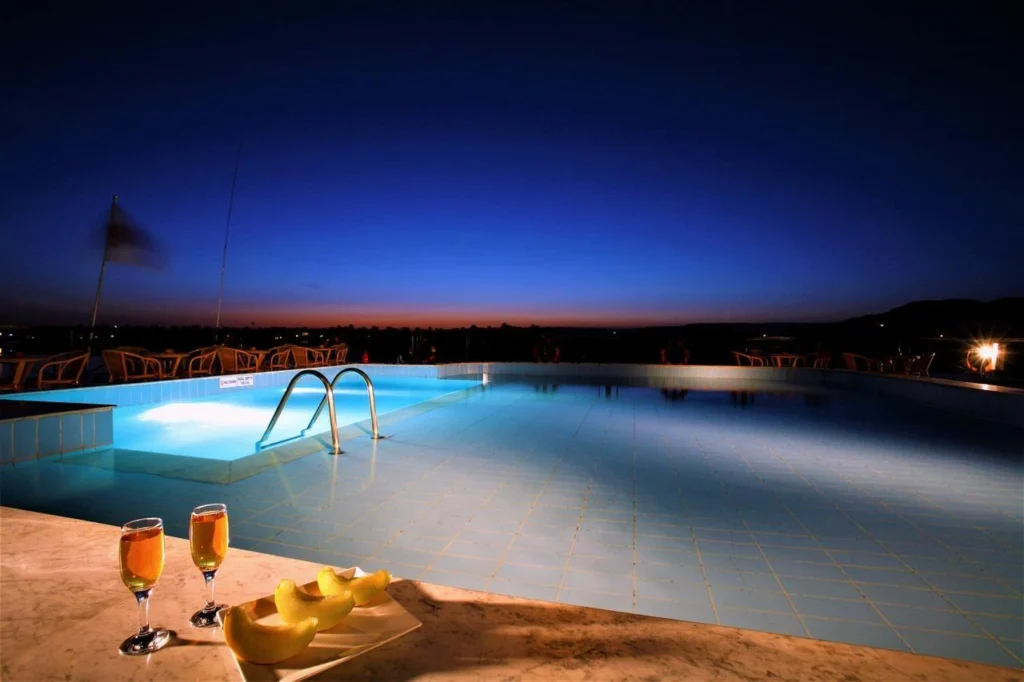
Deluxe ships light the pool and keep the deck open late — one of the few differences you can actually see in the price.
What families pay
Children are priced differently on almost every ship, and the differences are large enough to change which boat you should book.
The common structure is free or heavily reduced for under-twos, roughly 50 percent off for ages two to eleven when sharing a cabin with two adults, and full adult rate from twelve. Some ships run the child rate to fourteen. A few charge full price from six, which is worth knowing before you fall in love with a particular boat.
The variable that matters most is whether a cabin takes a third and fourth bed. Many do not — Nile cruise cabins are small, and a rollaway in a 20-square-metre room with a family of four in it is a long four nights. Ships that offer connecting cabins or genuine family cabins are a much better answer, and they cost less than booking two separate doubles.
Two adults and two children aged eight and ten, sharing one family cabin on a deluxe ship for four nights, typically lands at $2,600 to $3,400 including extras. The same family in two separate double cabins would pay closer to $4,000 for an identical trip. Ask specifically about family cabin configurations before you compare quotes, because two operators quoting the same ship may be quoting completely different room arrangements.
One further note: children’s tips are usually calculated at the adult rate for the crew envelope, since the housekeeping and catering load is the same. Guides often waive or reduce the per-child amount.
How to actually pay less
Move your dates by two weeks. The difference between 18 December and 8 January is enormous. The difference between 8 January and 20 January is often 25 percent.
Take the three-night Aswan to Luxor. You see every major temple. You save 20 to 25 percent.
Take a lower deck cabin on a better ship rather than an upper deck cabin on a worse one. The ship determines your food, your service and your guide. The deck determines your window.
Book the domestic flights separately if your operator marks them up. Check EgyptAir direct before accepting a bundled fare.
Skip the sound and light show. Genuinely. It is $20 to $25 for a dated production, and most people who have seen Karnak in daylight find it an anticlimax.
Do Abu Simbel by road, not air. $85 to $160 versus $200 to $300. It is a long day either way, but the road version costs half as much and you see Lake Nasser.
Month-by-month pricing sits in our best time to cruise guide. What we would not cut: the guide, or the star rating. Those are the two places where saving $150 costs you the trip.
Frequently asked questions
How much does a 3-day Nile cruise cost?
A 3-night, 4-day cruise from Aswan to Luxor costs $450 to $900 per person on a deluxe 5-star ship, including full board, temple entrance fees and a guide. Standard ships start around $360.
Are meals included in a Nile cruise?
Yes. Every Nile cruise includes breakfast, lunch and dinner. Water is usually included at meals. Soft drinks, beer, wine and cocktails are almost always extra.
Are temple entrance fees included?
On a properly packaged cruise, yes — Philae, Kom Ombo, Edfu, Karnak and the standard Valley of the Kings ticket. Abu Simbel is not. Extra tombs such as Tutankhamun and Seti I carry separate tickets.
How much should I budget for tips?
Around $6 to $8 per person per day for the crew and the same again for your guide. Over four nights that is $45 to $65 per person. Tips are not optional in practice.
Is a luxury Nile cruise worth the extra money?
It depends entirely on how much crowding bothers you. The temples and the itinerary are identical. What you buy is a smaller group, more space and better food. If arriving at Edfu with 600 other people would spoil your morning, it is worth it. If it would not, it is not.
When are Nile cruises cheapest?
May through August, when prices drop 30 to 50 percent below average. Luxor averages 41 to 42°C in June and July, so excursions start before dawn.
Can I negotiate the price of a Nile cruise?
Some, in low season and close to departure, when boats have unsold cabins. Almost never over Christmas, New Year or Easter. Asking what is available rather than asking for a discount tends to work better.
How much does a Nile cruise cost for a family of four?
Two adults and two children on a deluxe 4-night cruise typically comes to $2,600 to $3,400 including extras. Most ships offer child reductions of 25 to 50 percent when children share a cabin with two adults, and some allow a third and fourth bed in one cabin, which changes the maths considerably.
Want a written price for your dates?
Send us your dates and a rough budget — a specialist replies with three ships across categories, live availability and a written price. No online payment.
Written byMagdy Fattouh38 guides published on this site
Magdy Fattouh is a Cairo University history graduate and the writer behind the guides on this site. Over 13 years he has researched and written about Egypt's history, its monuments and how to travel to them — from the pharaohs and the temples to month-by-month planning, ship comparisons and day-by-day itineraries. He speaks English and Arabic, and reviews every guide here for accuracy before it is published.
Read more by Magdy Fattouh →
Ten to seventeen hours depending on your coast, and a seven to ten hour time shift. Why twelve days beats seven, how to sequence Cairo, and what Thanksgiving…
Five hours direct from London with a one-hour time difference. What ATOL does and does not cover on a direct booking, sterling costs, and why February half term…
We use essential cookies to make this site work. With your permission we also use Google Analytics cookies to understand how the site is used, so we can improve it. We never use cookies for advertising. Cookie Policy
Strictly necessaryRemember your cookie choice and keep the site secure. Always on.
Always on
Google Analytics: which pages are visited and how people find us. No personal profile, no advertising.


 Planning