Budget $8 to $10 per person per day in total. Roughly $3 to $5 goes to the crew through the pooled envelope at the end of the cruise, $5 to your Egyptologist and $2 to drivers. Small US dollar notes or Egyptian pounds both work. Tipping is expected but never demanded, and it is not included in the fare.
Budget $6 to $8 per person per day for the ship’s crew and the same again for your Egyptologist guide. On a 4-night cruise that comes to roughly $45 to $65 per person in total. The crew tip goes into one envelope left at reception on your last evening. The guide is tipped separately, by hand.
Nobody explains this before you arrive, and then on the last night everyone on the boat is quietly asking everyone else what they are giving. So here is the whole thing, with actual numbers.
Key takeaways
Budget $8 to $10 per person per day in total.
Roughly $3–5 for the crew, $5 for your Egyptologist, $2 for drivers.
The crew tip goes into a pooled envelope at reception on the last evening.
Small US dollars or Egyptian pounds both work; cards do not.
The simple version
Who
Per person, per day
Total over 4 nights
Ship crew (one shared envelope)
$6 – $8
$24 – $32
Egyptologist guide
$6 – $8
$24 – $32
Driver, per transfer
—
$2 – $4
Small baksheesh, ad hoc
—
$5 – $10
Realistic total
$55 – $80
Per person. A couple should budget roughly $110 to $160 for a 4-night cruise, all in.
If you want one number to carry in your head: about $15 per person per day covers everything, crew and guide and the small stuff. Round it to $60 each for a four-night trip and you will be somewhere between generous and correct.
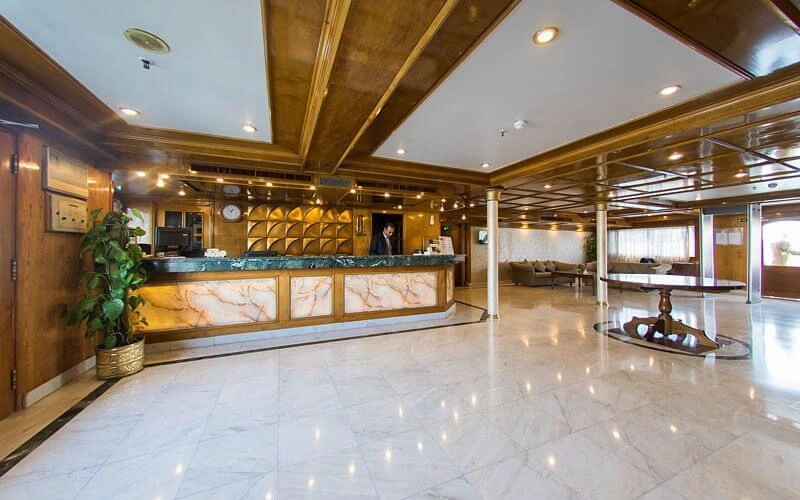
The pooled crew envelope is handed in at reception on the last evening — not to individuals during the cruise.
Who you actually tip
The crew envelope
Almost every Nile cruise ship pools crew tips. You leave one envelope at reception, usually on the final evening or the morning you disembark, and it is divided among everyone who works on board — waiters, housekeeping, kitchen staff, deck crew, the people you never see.
This is a good system and you should use it rather than tipping individuals. Tipping only the waiter who was nice to you means the person who cleaned your bathroom for four days gets nothing.
Reception will normally hand you an envelope on day three without being asked. If they do not, ask for one. There is no awkwardness in it — it is entirely routine.
Your Egyptologist guide
Tipped separately, directly, in your hand to theirs, on your last excursion together.
The guide is the single biggest variable in whether you enjoy this trip, and the range people give reflects that. $6 to $8 per person per day is the standard. For someone who has been genuinely excellent — who took your questions seriously, who got you into the tomb before the coaches arrived, who made Kom Ombo mean something — $10 to $12 a day is not excessive and will be remembered.
If you are a family or a group of four or more, the per-person figure can come down somewhat. A guide managing six people is not doing three times the work of a guide managing two.
Your driver
Airport transfers, the run to Abu Simbel, the West Bank circuit. $2 to $4 per transfer for a short run, $8 to $12 for a long day like Abu Simbel, split across the vehicle rather than per person.
Everyone else
The felucca captain on an afternoon sail: $2 to $3 per person. The man with the horse and carriage at Edfu: a small note, and only if you are happy. The person who appears from nowhere at a temple to point at something and then wants paying: entirely at your discretion, and it is fine to say no.
Dollars or Egyptian pounds?
Both work. Here is the honest breakdown, because advice on this is contradictory everywhere.
US dollars are fine and widely welcomed for the crew envelope and the guide. They are stable, everyone in Egyptian tourism handles them, and nobody will be disappointed. Bring clean, undamaged, post-2009 notes — older or torn US bills are frequently refused by Egyptian banks, so people are wary of them.
Egyptian pounds are better for everything small. The carriage driver, the felucca captain, the man in the temple. Handing someone a five-dollar bill for a two-dollar service means they have to go and change it, which costs them time and a commission.
Euros and British pounds are accepted but less enthusiastically. Change is harder to get and the rate is worse.
One thing to avoid: tipping in coins of any currency. Egyptian banks will not exchange foreign coins, so a handful of euro cents is literally worthless to the person receiving it.
Tip the guide separately. The pooled envelope is for the crew — your Egyptologist is not part of it and is usually thanked at the last site.
Small notes: why you need them
This is the practical detail that makes the difference between smooth and awkward, and it is the one thing we tell every traveller before they fly.
You will need a supply of small denominations — 10, 20 and 50 Egyptian pound notes, plus $1 and $5 bills. Not because anything costs that much, but because the alternative is standing there holding a 200-pound note for a service worth twenty and doing arithmetic in front of someone.
Where to get them: ask at your hotel reception in Cairo before you fly south, or break a larger note at a shop early in the trip. ATMs dispense large denominations almost exclusively, so you cannot rely on them for this. Get sorted on day one and the rest of the trip is frictionless.
Your Egyptologist is tipped separately from the crew, usually at the end of the last excursion.
Worked example: a couple, four nights
Item
Amount
Crew envelope, 2 people × 4 days × $7
$56
Guide, 2 people × 4 days × $7
$56
Airport transfer in
$3
Abu Simbel driver, full day
$10
Felucca captain
$5
Airport transfer out
$3
Assorted baksheesh
$12
Total for two
$145
Bring $160 in cash earmarked for tipping and you will not have to think about it again. It is one line in the wider cost of a Nile cruise.
When to tip less, or not at all
Tips are never included in your cruise fare. But tipping in Egypt is customary, not compulsory, and you are allowed to exercise judgement.
If your guide spent the week steering you into his cousin’s papyrus shop, tip at the bottom of the range or below it. If someone follows you around a temple offering unwanted commentary and then demands payment, you can decline. A firm, friendly la shukran — no thank you — works, and is not considered rude.
What you should not do is withhold the crew envelope because of a bad experience with one person. The kitchen staff did not cause your problem. Raise the specific issue with the cruise manager instead, on the day, when it can still be fixed.
Baksheesh, and why it feels strange at first
Visitors often arrive expecting tipping to work the way it does at home — a reward for service above expectation — and find something different.
Baksheesh covers a wider range than the English word “tip”. It includes gratuities, but also small payments for small favours and a general circulation of money toward people who need it. Wages across Egyptian tourism are low and tips are not a bonus on top of a living wage; for many crew members they are a substantial part of what they earn.
Understanding that makes the whole thing easier. The frequency is not pushiness. It is how a large part of the economy functions, and $2 that is inconsequential to you is not inconsequential at the other end of the transaction.
That said — you are not obliged to pay for something you did not ask for. Both things are true at once.
The crew box at reception is the usual route for the general tip; the guide and driver are tipped separately.
What about ships that add a service charge?
A handful of the newer and more expensive ships now add a service charge to your onboard account, usually 10 to 12 percent on bar bills and sometimes a flat daily amount per cabin.
Read what it covers. A service charge on drinks is not the same thing as the crew gratuity, and on most ships it goes to the bar operation rather than into the general crew pool. If your ship applies a daily service charge across the board and states in writing that it replaces the crew envelope, then you are done and you tip only your guide. That is rare on the Nile but it does exist, mostly on dahabiyas and at the top of the luxury bracket.
If it is not stated in writing, assume the crew envelope still applies. Ask the cruise manager on day one rather than guessing on day four.
Tipping on a dahabiya is different
Smaller boat, smaller crew, much more contact. On a dahabiya you may have six crew for twelve guests and you will know all of their names by the second morning.
The rate runs higher — typically $10 to $15 per person per day for the crew — because the service is more personal and the crew is smaller, so the pool is divided fewer ways. Many dahabiya operators include gratuities in the fare precisely to remove the awkwardness. Check your booking documents; if it says gratuities included, believe it and do not double-tip out of anxiety.
Bar staff are covered by the crew box on most ships, so there is no need to tip drink by drink.
Five mistakes people make
Arriving with no small notes. The most common one, and the most easily avoided.
Tipping individual crew members instead of the envelope. It cuts out the people who work where you cannot see them.
Bringing old or torn dollar bills. Pre-2009 US notes are regularly refused. Bring clean ones.
Leaving the crew envelope until the last five minutes. Disembarkation is chaotic. Hand it in the evening before.
Over-tipping enormously on day one. Understandable, and it sets a rate you then have to sustain for four days. Start at the standard.
Frequently asked questions
How much do you tip on a Nile cruise?
Budget $6 to $8 per person per day for the ship’s crew and the same again for your guide. On a 4-night cruise that is roughly $45 to $65 per person, or $110 to $160 for a couple including drivers and small baksheesh.
Is tipping included in a Nile cruise price?
Almost never. A small number of luxury ships and dahabiyas include gratuities — if yours does, it will be stated explicitly in your booking. Assume it is not included unless you have seen it in writing.
Should I tip in dollars or Egyptian pounds?
Dollars for the crew envelope and the guide; Egyptian pounds for anything small. Bring clean, post-2009 US notes. Do not tip in foreign coins — Egyptian banks cannot exchange them.
When do I give the crew tip?
On the final evening, in the envelope reception provides, handed in at the front desk. Not on the morning of disembarkation, when everything is rushed.
Do I tip the guide separately from the crew?
Yes. The guide is not part of the ship’s crew pool. Tip them directly, in hand, at the end of your last excursion together.
What if I am unhappy with the service?
Speak to the cruise manager while there is still time to fix it. If the issue was one individual, reduce that individual’s tip rather than the shared crew envelope, which supports staff who had nothing to do with it.
How much do I tip on a 7-night cruise?
The daily rate is the same, so roughly $85 to $110 per person for the crew and guide combined across seven nights. Some travellers tip the crew at the midpoint and again at the end on longer sailings.
Do I need to tip at temples?
No. Entrance is covered by your ticket, and site guardians who offer to show you something extra are working for baksheesh, not on official duty. A small note is normal if you accept the offer, and declining is perfectly acceptable if you do not.
Anything else you want in writing?
Send us your dates and a rough budget — a specialist replies with three ships across categories, live availability and a written price. No online payment.
Written byMagdy Fattouh38 guides published on this site
Magdy Fattouh is a Cairo University history graduate and the writer behind the guides on this site. Over 13 years he has researched and written about Egypt's history, its monuments and how to travel to them — from the pharaohs and the temples to month-by-month planning, ship comparisons and day-by-day itineraries. He speaks English and Arabic, and reviews every guide here for accuracy before it is published.
Read more by Magdy Fattouh →
The tourist visa is $30 on arrival or online, valid 30 days. Bring clean US dollars in small denominations, and get Egyptian pounds for everything minor. Plus SIMs,…
We use essential cookies to make this site work. With your permission we also use Google Analytics cookies to understand how the site is used, so we can improve it. We never use cookies for advertising. Cookie Policy
Strictly necessaryRemember your cookie choice and keep the site secure. Always on.
Always on
Google Analytics: which pages are visited and how people find us. No personal profile, no advertising.





 Practical