Three meals a day are included on every ship. Breakfast and lunch are international buffets with an Egyptian corner; dinner is either a buffet or a set menu with table service depending on the ship. Vegetarian, gluten-free and halal are standard if you tell the ship in advance. Only water is included with meals.
Three buffet meals a day, mixing Egyptian and international dishes, included in your fare — but drinks are not. Breakfast has eggs cooked to order, lunch is served while sailing, dinner is a buffet on most ships and table service on luxury ones. The food is better than people expect and more repetitive than they hope. Flag dietary requirements when you book, not at the buffet.
Nobody writes about this honestly because the honest version is “it’s fine, and by day four you’ve seen it all”. Which is true, and there is more to say.
Key takeaways
Three meals a day are included on every ship in every category.
Breakfast and lunch are buffets; dinner is a buffet or a set menu depending on the ship.
Vegetarian, gluten-free and halal are standard if you give notice.
Only water is included with meals — everything else is a bar bill.
The meal pattern
Meal
Typical window
Format
Breakfast
6:00 – 9:30
Buffet, eggs to order
Lunch
13:00 – 15:00
Buffet, while sailing
Afternoon tea
16:30 – 17:30
Tea, coffee, pastries on deck
Dinner
19:30 – 21:00
Buffet, or served on luxury ships
On early-start days the kitchen puts out a reduced breakfast before the excursion and a full one when you get back. In summer, when you leave at 5:30, ask reception the night before for a boxed breakfast. Every ship does it and almost none advertise it.
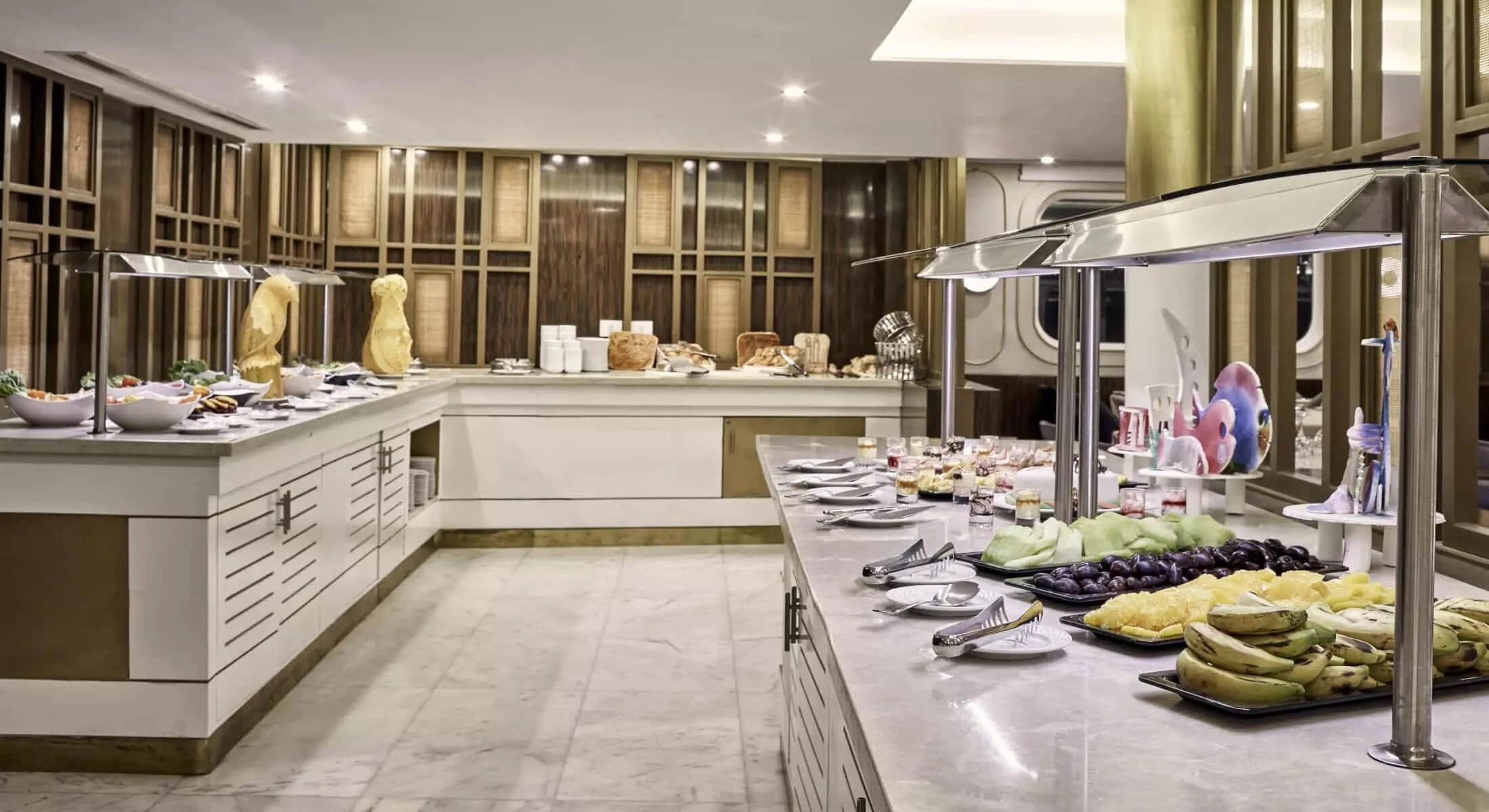
The buffet counter is where most ships are judged. Ask about the Egyptian dishes — they are usually the best thing on it.
What is actually on the buffet
Breakfast is the most consistent meal and often the best. Eggs cooked to order, Egyptian flatbread, fuul (slow-cooked fava beans, the national breakfast), feta and white cheeses, olives, tomatoes and cucumber, fresh fruit, pastries, yoghurt, juices. Coffee is usually instant unless you pay for espresso.
Lunch leans international with Egyptian dishes alongside. Salads, grilled chicken or fish, rice, pasta, a stew or two, bread, and a dessert table.
Dinner is the same structure with more of it — a soup, a carving station on better ships, three or four hot mains, and a larger dessert spread.
The Egyptian dishes worth trying rather than defaulting to pasta: koshari (rice, lentils, macaroni, fried onions, spiced tomato sauce), molokhia (a green leaf soup that divides people sharply), mahshi (stuffed vine leaves, peppers or courgettes), tagine stews, and om ali for dessert — a bread-and-milk pudding with nuts and raisins that is the one everyone asks for the recipe to.
How good is it, really?
Competent hotel-buffet standard on a deluxe ship. Good ingredients, cooked in volume, held in trays.
Where it is genuinely strong: the bread, the fresh vegetables and salads, the fruit, and the grill or carving stations where things are cooked in front of you. Where it is weakest: anything that has been sitting in a bain-marie, and the coffee.
Four nights is fine. Seven is where the rotation shows. Kitchens work a menu cycle of roughly four to five days, so on the 7-night round trip you meet the same dishes twice. It is one of several arguments for four nights over seven.
On luxury ships and dahabiyas the difference is real. A dahabiya with twelve guests cooks to order rather than to a buffet, and the food is one of the clearest things you are paying for.
Ask for the Egyptian dishes. The international buffet is fine; the molokhia, the tagines and the fresh bread are what you will remember.
Drinks are not included
The single biggest surprise on the final bill, so we will be blunt about it.
Full board covers food. Water is poured at meals. Everything else is charged to your cabin account, and on most ships that includes the bottled water in your cabin fridge.
Item
Typical onboard price
Bottled water
$1 – $2
Soft drink
$2.50 – $4
Local beer (Stella, Sakara)
$4 – $6
Egyptian wine, by the glass
$5 – $8
Cocktail
$7 – $12
Espresso drinks
$2 – $4
A couple drinking moderately over four nights runs up $80 to $140. Buy water ashore if you want to control it — a 1.5-litre bottle costs a fraction of the onboard price and nobody minds you bringing it aboard.
Some luxury ships and most dahabiyas do include soft drinks; a few include local beer and wine. If yours does, it will say so explicitly. Full detail in what’s included in a Nile cruise.
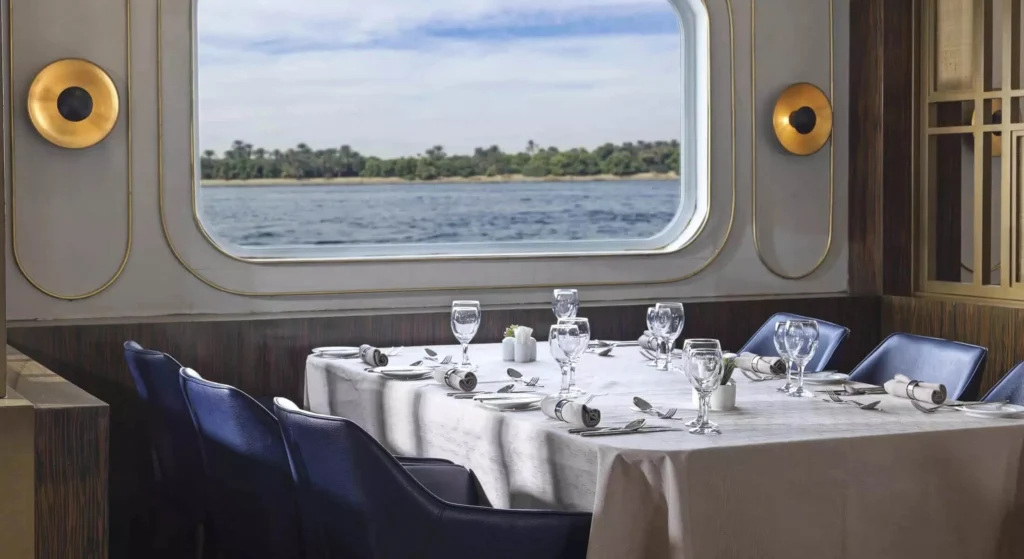
Single-sitting restaurants mean you are never given a fixed meal time on the better ships.
Vegetarian, vegan and special diets
Vegetarian is easy. A large part of Egyptian cooking is naturally meat-free — fuul, koshari, hummus, baba ghanoush, lentil soup, stuffed vegetables, and the salad and mezze tables. You will not go hungry and you will not be eating side dishes.
Vegan takes notice. Doable, but ghee, yoghurt and egg turn up in places you would not expect. Tell your operator at booking.
Gluten-free, nut allergies and other medical diets must be flagged at the time of booking. This matters more on a river ship than at a hotel: these kitchens provision fully before departure and cannot restock mid-river. A chef told three days ahead can plan; a chef told at Wednesday’s buffet cannot.
Halal is the default across the fleet. Pork is rare and clearly labelled where it exists.
Eating safely
Stomach upsets are the most common complaint on any Egypt trip, and they are largely avoidable.
Bottled water only, including for brushing teeth. Check the seal is intact.
Ice on reputable ships is made from filtered water and is fine. Ashore, be more careful.
Salads and unpeeled fruit are the usual culprits. Ships wash produce properly; roadside stalls are a different proposition.
Eat from the busy trays. High turnover means it has not been sitting.
Bring stomach medication from home. You want it in your cabin at 2am.
The pattern we see is that people are careful on board and casual ashore, and it is the ashore part that catches them.
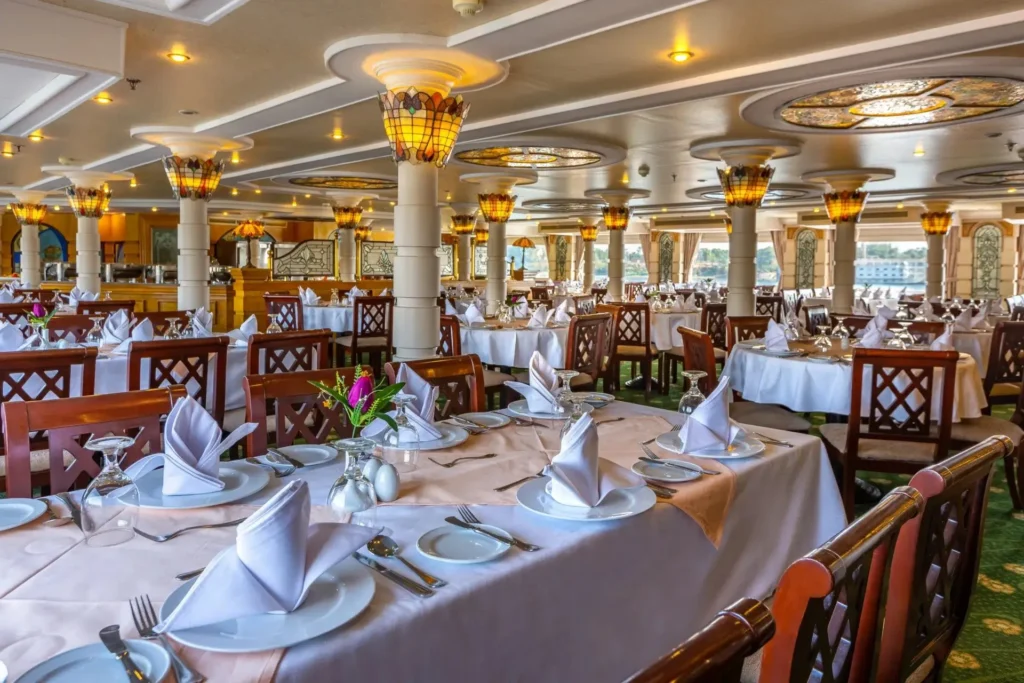
Dinner is the sit-down meal on almost every ship, with breakfast and lunch served as a buffet.
How it differs by ship class
Standard 4-star
Deluxe 5-star
Luxury / dahabiya
Dinner format
Buffet
Buffet, some served
Table service or cooked to order
Hot main choices
2 – 3
4 – 6
Set menu, higher quality
Live cooking station
Rare
Usually one
Not needed
Bread
Baked on board
Baked on board
Baked on board
Drinks included
No
No
Often soft drinks
Special diets
Basic accommodation
Handled well with notice
Handled easily
The gap between standard and deluxe is real but not dramatic — more choice rather than better cooking. The gap between deluxe and a small boat cooking for twelve people is much larger, and it is one of the clearest things the price difference actually buys.
Practical notes on the dining room
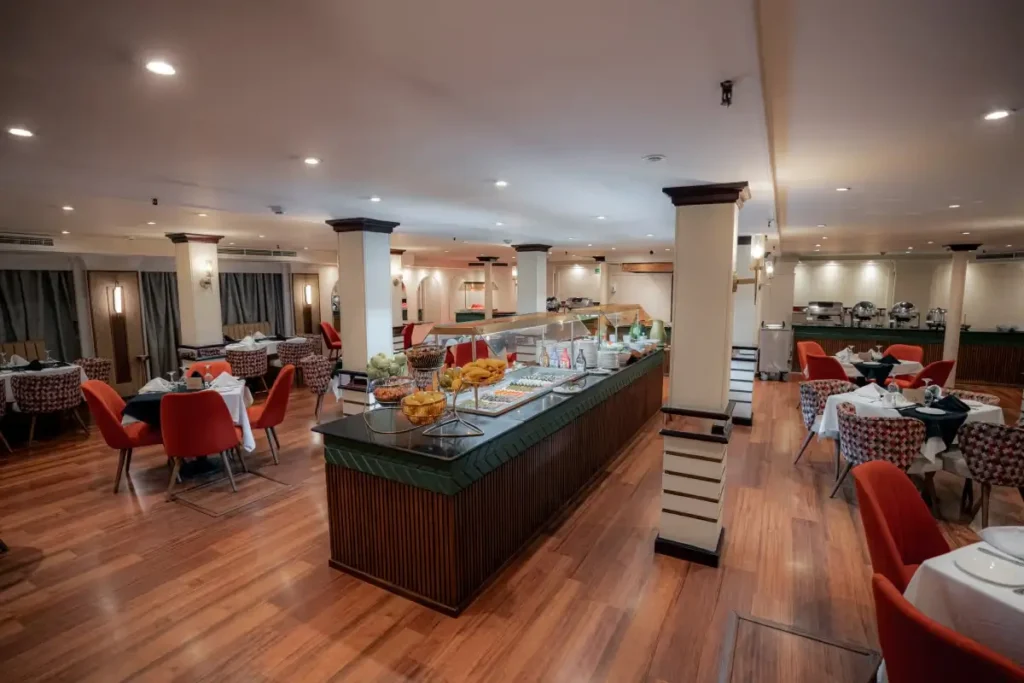
Seating is usually open rather than assigned, though some ships allocate tables for the first dinner so the waiters can learn who you are. If you would rather not share a table with strangers, say so at the first meal and it is arranged without fuss.
Meal times are fixed and tight, because they work around excursions. Turning up at 21:15 for dinner means the hot food has gone. If you are coming back late from an excursion, tell reception and they will hold something.
Room service exists on most deluxe ships and is often charged. It is rarely worth it on a boat this size — the restaurant is two flights away.
Dress is smart-casual for dinner across the fleet: a collared shirt or a blouse. Nobody wears formal wear. Details in what to wear on a Nile cruise.
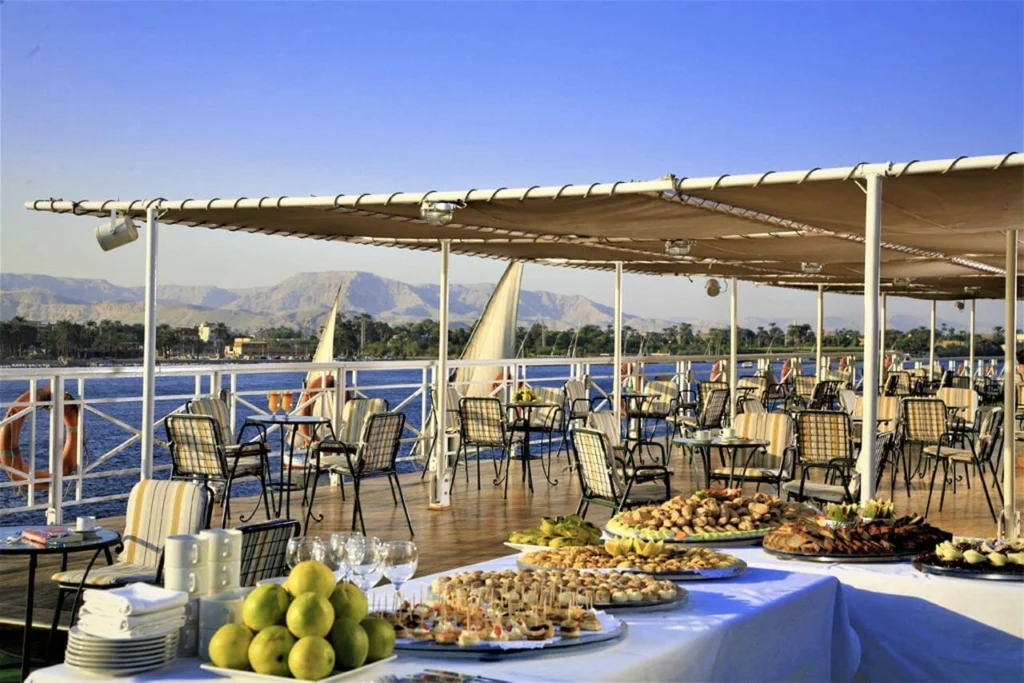
Some ships move the buffet onto the shaded deck when the weather allows — worth asking for at booking.
Eating off the ship
Worth doing at least once, and easy to fit in.
In Aswan, the Nubian restaurants on Elephantine Island and the west bank serve tagines and grilled fish, and tea on one of the riverside terraces is worth it for the view alone. In Luxor, the restaurants along the corniche near the temple do decent grills, and the local koshari places are excellent and cost almost nothing.
Tell reception if you plan to eat ashore so the kitchen is not holding a table. Nobody minds, and you are not charged less for a meal you skip.
Frequently asked questions
Is food included on a Nile cruise?
Yes — breakfast, lunch and dinner every day, plus afternoon tea on most ships. Drinks other than water at meals are not included.
What is the food like on a Nile cruise?
Buffet-style, mixing Egyptian and international dishes, at competent hotel standard on a deluxe ship. Strong on bread, salads and grilled items; weaker on anything held in a warming tray.
Are drinks included?
Rarely. Water is poured at meals; soft drinks, beer, wine and even cabin water are usually charged. Expect $80 to $140 for a couple over four nights.
Is there vegetarian food on Nile cruises?
Plenty. Much of Egyptian cooking is naturally vegetarian — koshari, fuul, hummus, lentil soup, stuffed vegetables. Vegan needs advance notice as ghee and yoghurt are common.
Can they handle gluten-free or allergies?
Yes, if you tell them when you book. Ships provision before departure and cannot restock mid-river, so notice at booking matters more than at a hotel.
Is the food safe to eat?
On reputable ships, yes. Stick to bottled water, be sensible with salads ashore, and bring stomach medication as a precaution.
Is the food halal?
Yes, by default across the fleet. Pork is rare and clearly labelled where served.
Does the menu repeat?
Kitchens run a four to five day cycle, so on a 4-night cruise you rarely see a repeat. On a 7-night round trip you will.
Dietary needs? Tell us before you book
Send us your dates and a rough budget — a specialist replies with three ships across categories, live availability and a written price. No online payment.
Written byMagdy Fattouh38 guides published on this site
Magdy Fattouh is a Cairo University history graduate and the writer behind the guides on this site. Over 13 years he has researched and written about Egypt's history, its monuments and how to travel to them — from the pharaohs and the temples to month-by-month planning, ship comparisons and day-by-day itineraries. He speaks English and Arabic, and reviews every guide here for accuracy before it is published.
Read more by Magdy Fattouh →
The tourist visa is $30 on arrival or online, valid 30 days. Bring clean US dollars in small denominations, and get Egyptian pounds for everything minor. Plus SIMs,…
We use essential cookies to make this site work. With your permission we also use Google Analytics cookies to understand how the site is used, so we can improve it. We never use cookies for advertising. Cookie Policy
Strictly necessaryRemember your cookie choice and keep the site secure. Always on.
Always on
Google Analytics: which pages are visited and how people find us. No personal profile, no advertising.


 Practical