The Luxor to Aswan corridor is the most heavily policed tourist route in Egypt and cruise passengers rarely encounter a problem. The genuine risks are heat, stomach upsets and persistent selling at the sites — not violence. Solo women travel this route routinely; the usual advice about dress and confident refusal applies.
The Cairo–Luxor–Aswan–Red Sea tourist corridor is considered safe for visitors, and a Nile cruise sits entirely within it. Major sites have dedicated tourist police, ride-hailing apps operate in all the main cities, and the risks travellers actually meet are social rather than physical — persistent vendors, commission scams, and overcharging. Check your own government’s current advisory before you book, since those change.
We are an Egyptian company, so treat our reassurance with appropriate scepticism and read the specifics rather than the summary. We have also tried to be honest about the things that genuinely annoy people, because pretending they do not exist helps nobody.
Key takeaways
The Luxor to Aswan corridor is the most heavily policed tourist route in Egypt.
The real risks are heat, stomach upsets and persistent selling — not violence.
Solo women travel this route routinely.
Ships hold passports at reception during the cruise; that is normal.
What the official position is
Foreign ministries generally advise normal precautions for the Nile Valley, Cairo and the Red Sea resorts, while advising against travel to parts of North Sinai and areas along the western desert borders. A Nile cruise goes nowhere near either.
Check the current advisory for your own nationality before booking — the UK FCDO, US State Department, Australian Smartraveller and their equivalents all publish and update these. Advisories move, and a page written in August is not a substitute for the live one. It also matters for insurance: policies typically become void if you travel against your own government’s advice.
Every major site on the route has controlled entry and a police presence at the gate.
Security you will actually notice
Egypt takes tourism seriously as an industry, and the visible infrastructure reflects that.
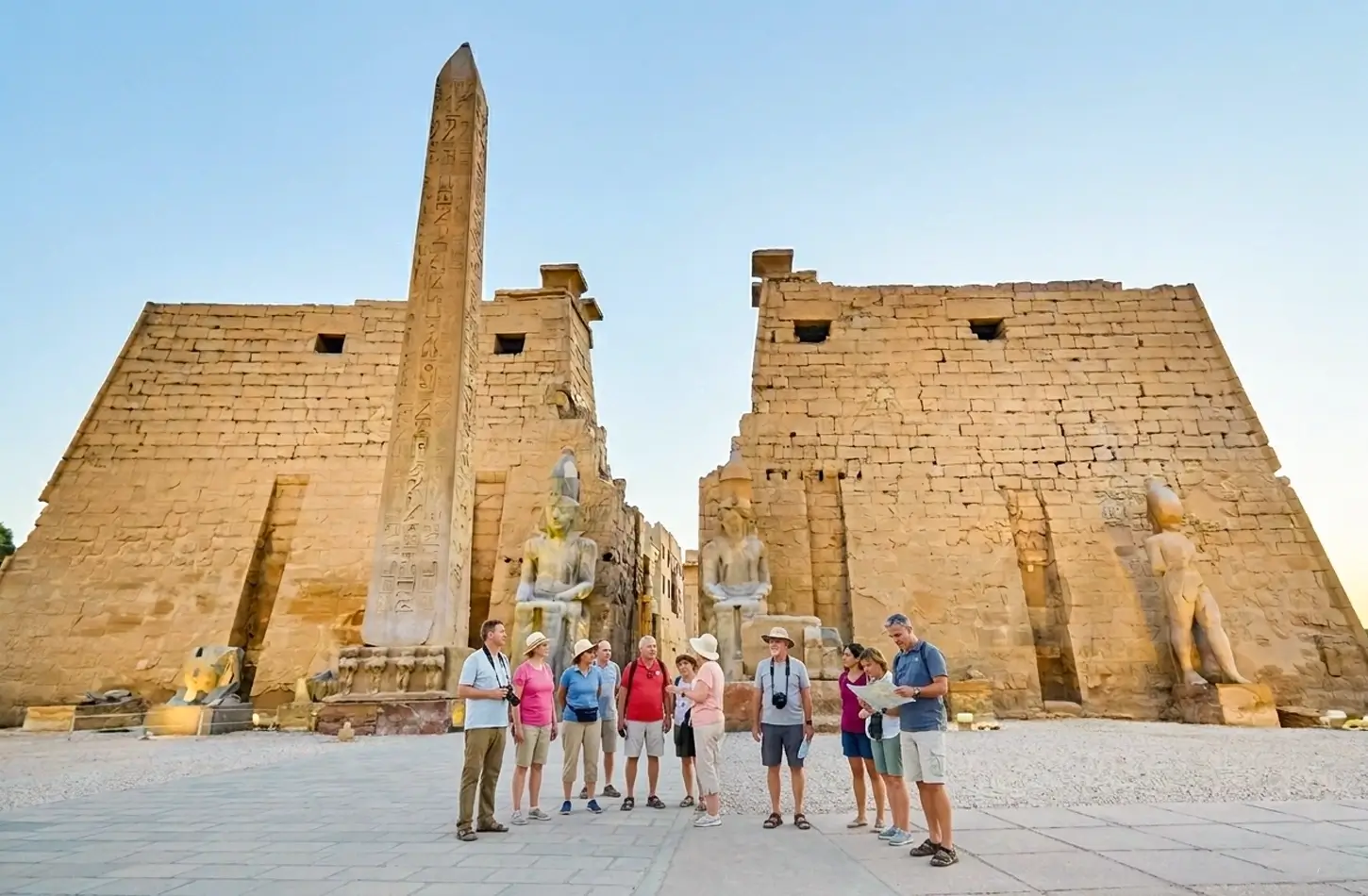
Tourist police are stationed at every major site — Karnak, the Valley of the Kings, Philae, Edfu, Kom Ombo. They are a separate branch, usually English-speaking, and approaching one is entirely normal.
Checkpoints on intercity roads, particularly the route south to Abu Simbel. You may be asked for your passport. It is routine and takes a couple of minutes.
Scanners and bag checks at hotels, museums and larger sites.
Boarding control at cruise docks. Ships are not open to the public and there is a checkpoint at the gangway.
Some visitors find the level of visible security reassuring and some find it unsettling. It is worth knowing it is there so it is not a surprise.
The things that actually bother people
This is the honest section, and it is where the real friction is.
Vendors and touts
At the exits of major sites, and in the souks, you will be approached repeatedly. It is persistent, it is close-range, and it wears people down by day three. It is not dangerous. It is exhausting.
What works: a firm, friendly la shukran — no thank you — without breaking stride, and not making eye contact with the goods. What does not work: engaging politely to explain why you do not want it.
Baksheesh at every turn
Someone will open a door, point at a carving, or offer to photograph you, and then want paying. This is normal here and not a scam — it is how a large part of the informal economy functions. You are allowed to decline. Our tipping guide covers what is customary and what is optional.
Commission scams
The common one: a guide or driver steers you to a papyrus shop, an alabaster factory or a perfume house where they take a cut. Prices in those places run several times the going rate.
You can simply say no. A guide who keeps pushing after you have declined is one to mention to your operator.
Overcharging
Taxis without meters, unofficial guides at site entrances, and inflated prices in tourist-facing shops. Use Uber or Careem where they operate, agree taxi prices before getting in, and only use guides supplied through your ship or operator.
A firm “la, shukran” and no eye contact ends almost every approach. Sellers at the temple gates are persistent, not threatening.
Is a Nile cruise itself safe?
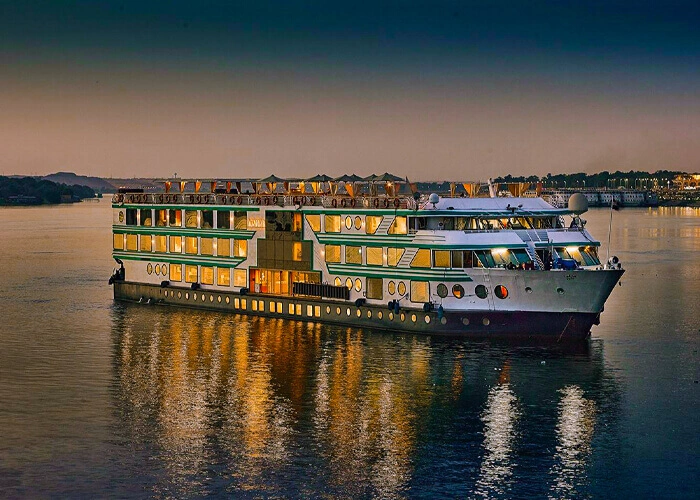
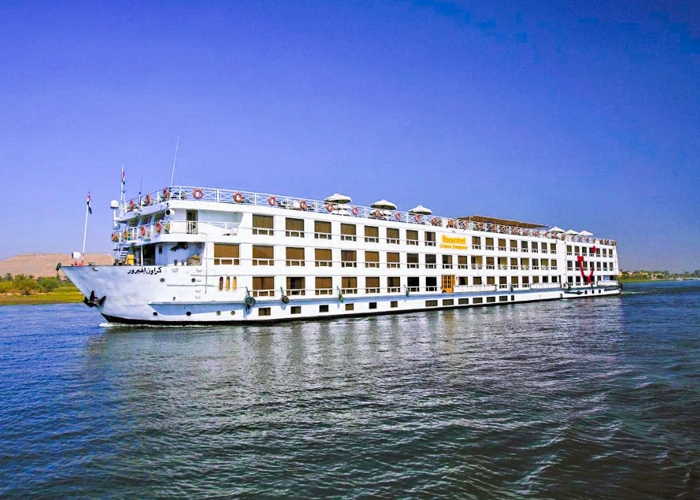
The cruise is the most controlled part of an Egypt trip.
You are on a vessel with access control, moving between docks in the tourist corridor, moving to sites in an operator’s vehicle with a licensed guide. There is very little unsupervised exposure unless you go looking for it.
The genuine risks on board are ordinary ones: heat, particularly in summer; stomach upsets from tap water or ice; and slips on wet decks and worn tomb ramps. None dramatic, all worth taking seriously.
Every ship has a doctor on call, and Luxor and Aswan both have hospitals used to treating foreign visitors.
Ships hold your passport at reception during the cruise — normal practice, and returned at the end.
Solo travellers
Luxor and Aswan are consistently described by solo visitors — including solo women — as the easiest cities in Egypt. Both are compact, heavily touristed, have tourist police at every major site, and have Uber and Careem operating.
A cruise is a particularly good format for solo travel: you are with the same small group each day, the guide knows who you are, and there is no evening logistics problem.
Practical notes from women who travel here regularly: dress modestly away from the ship and hotel (see what to wear), use ride-hailing rather than street taxis after dark, and a ring on the left hand reduces unsolicited attention noticeably. The issue is unwanted attention and comments rather than threat, and it is manageable.
Health and water
Drink bottled water only. Including for brushing teeth. Check the seal.
Ice on reputable ships is made from filtered water; ashore, be cautious.
Raw salad and unpeeled fruit are the usual culprits. Ships handle this well; street food is a different risk profile.
Bring stomach medication. Available in Egyptian pharmacies, but you want it in your cabin at 2am, not at 9 the next morning.
Heat is the most common medical issue we see. Drink more than you want to and take the electrolyte sachets.
No vaccinations are required for most travellers from Europe, North America or Australia, but check current guidance with a travel clinic six to eight weeks before departure.
Travelling with children and older parents
Two groups who ask about safety for different reasons, and the answers are different.
With children, the physical risks are ordinary — heat, dehydration, uneven ground at temples, and pool supervision, since ship pools have no lifeguard. Egyptians are warm toward children to a degree that surprises some visitors; expect your kids to be greeted, photographed and offered things constantly. It is friendly rather than intrusive, but worth preparing a child who dislikes attention.
With older travellers, the honest concerns are mobility and heat rather than crime. Tomb ramps are steep, handrails are inconsistent, and Hatshepsut’s courtyard has almost no shade. Ships have no lifts on most vessels, so a lower-deck cabin can mean stairs several times a day — ask about deck layout before booking, and see which deck to book.
Both groups should avoid June to August unless the heat genuinely does not trouble them.
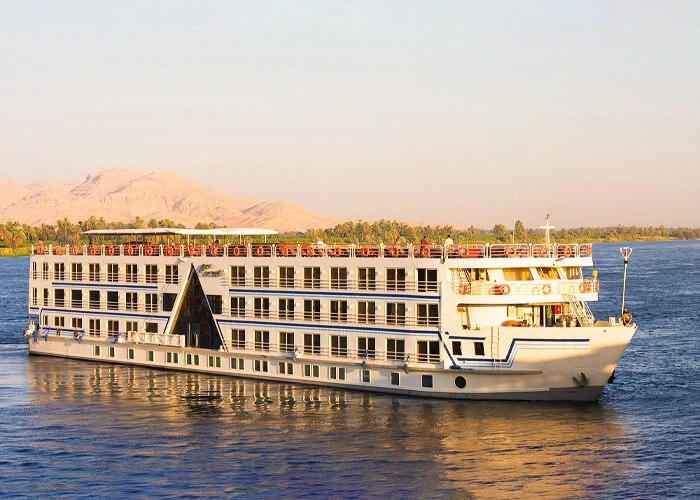
The Luxor–Aswan stretch is the most policed tourist corridor in Egypt, and the ships moor inside guarded quays.
Money and documents
Petty theft exists at the level you would expect in any busy tourist city, and no worse. Pickpocketing in crowded souks is the main one.
Use the cabin safe. Carry a copy of your passport and leave the original aboard except where checkpoints require it — the road to Abu Simbel is the main exception. Cards are widely accepted in hotels and on ships; markets and small excursions are cash.
Travel insurance
Not a legal requirement to enter Egypt, and you should have it anyway.
Two things to check specifically: that it covers medical repatriation, and that it covers the activities you are actually doing. Hot air ballooning is excluded by a surprising number of standard policies, and it is the one activity on this trip most likely to need cover.
Ships keep passports at reception for the river checkpoints — normal practice, and you get them back at disembarkation.
The short version
Egypt’s tourist corridor is well-policed, heavily practised at receiving visitors, and a Nile cruise is one of the more controlled ways to travel here. What will actually test your patience is being sold to, not being unsafe.
Read your own government’s live advisory, buy insurance that matches what you plan to do, drink bottled water, and use guides supplied through your operator rather than found at the gate. That covers almost everything.
If you have specific concerns about your dates or your group, ask us directly — we would rather answer a hard question than have you book something you are uneasy about.
Frequently asked questions
Is Egypt safe for tourists?
The Cairo–Luxor–Aswan–Red Sea corridor is generally considered safe, with tourist police at major sites. Advisories typically warn against North Sinai and western border areas, neither of which is near a Nile cruise route. Check your own government’s current advice before booking.
Is a Nile cruise safe?
It is the most controlled part of an Egypt trip — access-controlled ships, operator transport, licensed guides, and docks inside the tourist corridor. The real risks are heat, stomach upsets and slips.
Is Egypt safe for solo female travellers?
Luxor and Aswan are widely described as the easiest Egyptian cities for solo women. The common issue is unwanted attention rather than danger. Dressing modestly away from the ship and using Uber or Careem after dark both help noticeably.
Can I drink the tap water?
No. Use sealed bottled water, including for brushing teeth. Ice on reputable ships is made from filtered water.
Are there scams to watch for?
Mainly commission-driven shop visits, unofficial guides at site entrances, and unmetered taxis. Declining firmly works, and using guides supplied by your operator avoids most of it.
Do I need vaccinations for Egypt?
Generally none are required for travellers from Europe, North America or Australia, but check with a travel clinic six to eight weeks before you go.
Is travel insurance necessary?
Not legally required, but strongly advisable. Check that it includes medical repatriation and that it covers hot air ballooning if you plan to fly — many standard policies exclude it.
Are the temples and tombs physically safe?
Yes, with normal care. Tomb ramps are steep and dusty and handrails are inconsistent, so grip on your shoes matters more than most people expect.
Still have a question about safety?
Send us your dates and a rough budget — a specialist replies with three ships across categories, live availability and a written price. No online payment.
Written byMagdy Fattouh38 guides published on this site
Magdy Fattouh is a Cairo University history graduate and the writer behind the guides on this site. Over 13 years he has researched and written about Egypt's history, its monuments and how to travel to them — from the pharaohs and the temples to month-by-month planning, ship comparisons and day-by-day itineraries. He speaks English and Arabic, and reviews every guide here for accuracy before it is published.
Read more by Magdy Fattouh →
Ten to seventeen hours depending on your coast, and a seven to ten hour time shift. Why twelve days beats seven, how to sequence Cairo, and what Thanksgiving…
Five hours direct from London with a one-hour time difference. What ATOL does and does not cover on a direct booking, sterling costs, and why February half term…
We use essential cookies to make this site work. With your permission we also use Google Analytics cookies to understand how the site is used, so we can improve it. We never use cookies for advertising. Cookie Policy
Strictly necessaryRemember your cookie choice and keep the site secure. Always on.
Always on
Google Analytics: which pages are visited and how people find us. No personal profile, no advertising.


 Planning